





Key Takeaway: DNP Programs Without Clinicals (2026)
Duke University (Durham, NC): Offers an Executive Leadership DNP featuring online coursework and on-campus intensives.
Vanderbilt University (Nashville, TN): Provides tracks in Executive Leadership and Nursing Informatics focused on data and systems.
Johns Hopkins University (Baltimore, MD): Features an Executive track centered on leadership with several required on-site immersions.
University of Alabama (Birmingham, AL): A Post-MSN pathway for nurse executives that utilizes leadership-based practice work instead of rotations.
Wichita State University (Wichita, KS): An MSN-to-DNP option built around a specific DNP project and applied coursework.
Best Online DNP Programs Without Clinicals Details
The following schools have been selected based on allnurses' methodology of surveying our readers to understand what they value most, with the addition of graduation rates, student-faculty ratio, price, mode, duration, and admission rates of hundreds of the most prominent nursing schools in the United States.
1. Duke University
Duke University in Durham, North Carolina, offers an online DNP Executive Leadership Specialty Certificate for advanced practice registered nurses looking to step into high-level leadership roles. This program requires no clinical hours and focuses on strategic planning, financial and human resource management, and quality improvement to prepare nurses for executive positions in healthcare.
Designed for working professionals, the program blends asynchronous coursework with interactive online sessions, providing flexibility without compromising engagement. Students also participate in on-campus intensives, collaborating with faculty and peers who bring extensive nurse leadership experience. This structured approach ensures a comprehensive leadership education without traditional clinical training requirements.
DNP Executive Leadership Overview:
Duration: 21 months, 6 semesters
Credit Hours: 35
Accreditation: CCNE
Degree Level Required for Admission: MSN
Program Highlights:
Merges nursing science with leadership and business principles.
Trains in strategic decision-making, ethical leadership, and organizational management.
Fully online format, flexible for working professionals.
Taught by experienced nursing educators and leaders.
Extensive networking opportunities with peers, alumni, and industry experts.
Emphasizes practical learning through real-world projects and case studies.
Includes training in financial management, human resources, and quality improvement.
Culminates in a capstone project for practical application of skills.
Encourages a global perspective on healthcare leadership.
Offers continuous professional development through workshops and seminars.
2. Vanderbilt University
Vanderbilt University in Nashville, Tennessee, offers two standout online DNP tracks: the DNP Executive Leadership Track, designed for nurses pursuing executive roles, and the DNP Nursing Informatics Track, tailored for those specializing in data-driven healthcare innovation. Both programs provide flexible learning, combining asynchronous coursework, interactive online sessions, and on-campus intensives to support professional growth and collaboration.
The curriculum focuses on advanced leadership strategies, healthcare informatics, and policy-making, equipping nurses with the skills to navigate and influence complex healthcare systems. With cutting-edge online and distance-learning technology, students engage in virtual coursework and meaningful scholarly discussions, creating a dynamic educational experience.
A key feature is the customized practicum experience, where students collaborate with preceptors to apply evidence-based strategies and data-driven decision-making in real-world healthcare settings. This hands-on approach strengthens expertise in administration, informatics, and organizational leadership, preparing graduates for high-impact executive roles across healthcare environments.
DNP Executive Leadership Overview:
Duration: Approximately 2 years or 6 part-time semesters
Credit Hours: 36
Accreditation: CCNE
Degree Level Required for Admission: MSN or a BSN with a non-nursing master's degree
Program Highlights:
Combination of online and on-campus sessions
Designed for expert leaders to bring evidence-based knowledge into practice.
Aims to improve healthcare outcomes and strengthen executive nurse leadership.
Focuses on using nursing and scientific findings to design innovative and economically feasible care delivery programs.
Features actively practicing faculty who mentor students in evidence-based knowledge.
Leverages Vanderbilt's 100-year history in nursing leadership, teaching, practice, and research.
Provides multiple entry options for applicants with different educational backgrounds in nursing and health-related fields.
Ensures applicants are certified or eligible for certification in specific areas of nursing.
3. Johns Hopkins University
Johns Hopkins University in Baltimore, Maryland, offers an online MSN DNP Executive Track that stands out for its emphasis on leadership and policy innovation without requiring clinical hours. Designed for nurses looking to drive change at a systems level, the program focuses on advanced analytical skills, evidence-based decision-making, and strategic leadership.
A defining feature is its 4–5 on-site immersions (each lasting 3–4 days), providing hands-on learning and networking with healthcare leaders. The program also offers dual degree options, including a DNP/MPH with the Bloomberg School of Public Health and a DNP/MBA with the Carey Business School, giving students the opportunity to develop expertise in public health or business leadership.
DNP Executive Leadership Overview:
Duration: 2 years
Credit Hours: 40
Accreditation: CCNE
Degree Level Required for Admission: MSN
Program Highlights:
Focus on healthcare innovation and policy influence
Opportunities for collaboration and rigorous scholarship
Dual degree options available; DNP/MBA and DNP/MPH
Emphasizes data-driven decision-making in healthcare.
Integrates evidence-based practices for quality improvement.
Supports the development of leadership competencies in complex systems.
Offers mentorship and networking with experienced healthcare leaders.
Provides access to cutting-edge research and resources.
Encourages interdisciplinary collaboration for comprehensive learning.
What People Are Saying
I love Johns Hopkins School of Nursing, its a wonderful school with great faculty that cares, which is why I want to continue there with my advanced nursing education.
by FutureDNPAGPC. Join the conversation at Johns Hopkins University DNP - FNP/AGPC Fall 2024
4. University of Alabama at Birmingham
The University of Alabama at Birmingham offers a Post-MSN to DNP Pathway in Executive Leadership, designed to train nurses for top-level leadership roles in healthcare. This practice-focused terminal degree builds expertise in strategic decision-making, organizational management, and healthcare system improvement. The curriculum follows a distance-accessible format, combining online coursework with required on-campus intensives, ensuring flexibility while providing hands-on learning and networking opportunities.
DNP Nurse Executive Overview:
Duration: 2 years
Credit Hours: 43
Accreditation: CCNE
Degree Level Required for Admission: MSN
Program Highlights:
Focus on leading healthcare provision to populations and communities.
Emphasis on improving quality and access to health services.
Distance-accessible format with on-campus intensives.
Integration of advanced healthcare leadership principles.
In-depth exploration of health policy and ethics.
Focus on strategic management and organizational change.
Comprehensive financial aid and scholarship opportunities.
Involvement in impactful community and global health initiatives.
What People Are Saying
What I really like about UA is that you are awarded masters on the way to the DNP (many schools don't offer that). That was important to me to be able to walk away with something midway. I haven not heard it being difficult to transfer if need be.
by MinasMom. Join the conversation at University of Alabama Dual DNP FNP/PMHNP Spring 2025 applicants
5. Wichita State University
Wichita State University in Wichita, Kansas, offers a fully online MSN to DNP program with an Individual/Family Focus, making it a top choice for APRNs looking to advance their clinical expertise and leadership skills. This program integrates advanced coursework in pathophysiology, pharmacotherapy, healthcare systems, and leadership, preparing graduates to navigate complex healthcare challenges.
A key feature is the DNP Project, where students collaborate with faculty to address an evidence-based practice problem and implement real-world solutions. The program culminates in a residency experience, allowing students to refine their expertise and build a professional portfolio. With a strong focus on applied learning and healthcare innovation, this program provides a streamlined path for APRNs aiming to elevate patient-centered care and drive meaningful change.
DNP Individual/Family Focus Overview:
Duration: 2-3 years
Credit Hours: 29
Accreditation: CCNE
Degree Level Required for Admission: MSN
Program Highlights:
Fully online, practice-focused program tailored for APRNs.
Emphasis on evidence-based practice, healthcare leadership, and policy.
No clinical residency required, focusing instead on applied learning and research.
DNP Project designed to address real-world healthcare challenges.
Residency experience that builds a professional portfolio showcasing expertise.
Interactive online coursework with direct faculty engagement.
Flexible structure to accommodate working professionals while advancing clinical and leadership skills.
Tuition Comparison: Online DNP Programs Without Clinicals
| School | Credit Hours | Tuition Rate | Tuition Estimate* |
|---|---|---|---|
| Duke University | 35 | $2,250 per credit | ~$78,750 |
| Vanderbilt University | 36 | $2,057 per credit | ~$74,052 |
| Johns Hopkins University | 40 | $2,057 per credit | ~$82,280 |
| University of Alabama at Birmingham | 43 | $723 per credit (online courses) | ~$31,089 |
| Wichita State University | 29 | $350.73 per credit | ~$10,171 |
*Estimated tuition totals are calculated using published per-credit tuition multiplied by listed program credit hours. Totals typically exclude fees, books, travel for intensives, and any tuition changes.
Watch: DNP Without Clinicals? The "Non-Bedside" Path Explained
DNP Program Clinical Hour Requirements
While many non-APRN DNP programs eliminate traditional clinical hours, they still require experiential learning to ensure students develop advanced competencies. The minimum requirement for all accredited DNP programs is 1,000 post-bachelor practice hours, but these can be met through non-traditional methods, such as:
Scholarly projects addressing real-world healthcare challenges
Learning intensives with faculty and industry experts
Internships or leadership practicums tailored to the student's specialization
Specialized Online DNP Tracks Without Clinicals
Several DNP programs focus on non-clinical specializations, allowing nurses to advance their careers in areas beyond patient care:
Informatics: Focuses on health technology, data management, and digital health systems, preparing nurses for roles in health IT, data analytics, and informatics leadership.
Administration: Develops organizational and managerial expertise, equipping nurses for careers in healthcare management, policy development, and system leadership.
Leadership: Strengthens strategic decision-making, team management, and policy implementation for nurses pursuing executive leadership roles in healthcare.
Even without clinical hours, these programs ensure practical skill development through immersive projects, collaborative initiatives, and specialized internships, aligning with each nurse's chosen career path.
Online DNP Programs Without Clinicals Admission Requirements
| Requirement | What to Expect |
|---|---|
| Graduate degree | MSN (or a prior DNP in some cases) |
| RN license | Active, unencumbered RN license |
| APRN status (if applicable) | Current APRN certification for APRNs entering non-clinical tracks |
| Experience | RN clinical background preferred; leadership, informatics, quality, or admin experience helps |
| GPA | Often 3.0+ cumulative GPA |
| Prereqs | Commonly statistics; some programs also list Microbiology with lab |
| Application materials | 2–3 letters of recommendation, statement of purpose, and resume/CV |
| Interview (sometimes) | Video or in-person interview to confirm fit and goals |
| Clearance items | Background check, drug screen, immunizations, and proof of insurance (varies) |
Related...
Cheapest DNP Programs 2026
Best DNP Programs in the U.S. (2026)
Visual Guide: The Non-Clinical DNP: A Guide to Healthcare Leadership
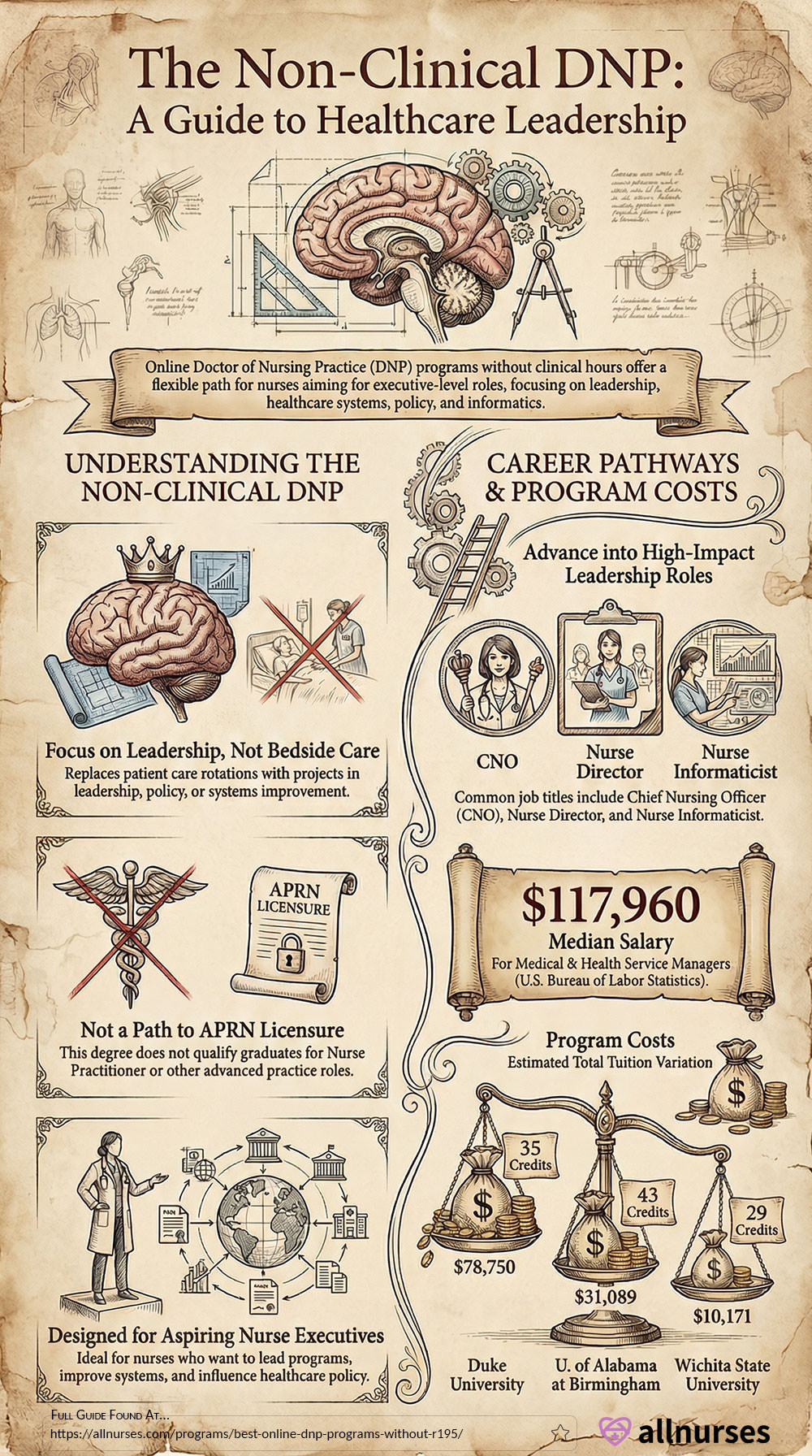

Use this graphic on your site:
2026 Non-Clinical DNP Salary Expectations
Earning a DNP without clinical hour requirements prepares professionals for diverse leadership positions in healthcare. These roles include:
Nurse Manager
Nurse Director
Chief Nursing Officer (CNO)
Nurse Educator
Healthcare Administrator
Nurse Informaticist
Nurse Researcher
Nurse Consultant
Salary prospects vary based on the specific role, the healthcare organization's size and nature, and geographic region, among other factors. However, data from the U.S. Bureau of Labor Statistics (BLS) reports the following median annual salaries:
- Medical & Health Service Manager $117,960
- Healthcare Administrator $137,730
- Health Information Technologists: $67,310
Furthermore, ZipRecruiter reports the following average salaries for DNP prepared nurses in non-clinical roles:
When evaluating the earnings potential of a non-clinical DNP, it's important to recognize that this degree is relatively new, and many institutions may not yet fully understand the value that DNP graduates bring. Breaking into this field as a nurse professional involves understanding the unique contributions of a DNP and effectively advocating for a salary that reflects these qualifications.
Pros and Cons of Online DNP Programs Without Clinicals
| Pros | Cons |
|---|---|
| No direct patient care hours: No bedside clinicals, which fits nurses focused on non-clinical goals. | Not APRN qualifying: Does not lead to NP or other advanced practice licensure. |
| Predictable scheduling: Plans and deadlines are often set in advance, with fewer last-minute changes. | Limited clinical growth: No new hands-on assessment or procedural skills added. |
| Leadership-focused: Emphasizes systems, policy, informatics, and executive decision-making. | Experience matters: Outcomes often depend on prior leadership or admin background. |
| Online coursework: Academic classes can often be completed without relocating. | Possible intensives: Some programs require campus visits that add travel and scheduling strain. |
| Applied projects: Project work replaces clinicals with real organizational or policy problems. | Project delays: Approvals and data access can slow progress more than coursework. |
DNP Scope of Practice & Certification
As you embark on your journey toward a Doctor of Nursing Practice (DNP) degree, it's important to understand the varied scope of practice, especially as a non-clinical or non-advanced Practice Registered Nurse (APRN) role. As future DNP nurse leaders, you will be esteemed professionals, upholding standards established by the American Nurses Association (ANA) and the American Nurses Credentialing Center (ANCC).
In formal leadership roles defined by the ANA, you will be entrusted with critical responsibilities. Your role will involve managing operational aspects within various healthcare settings. Your key duties will include:
Engaging in effective communication and strategic planning.
Producing measurable outcomes and accomplishments.
Enhancing your leadership skills continuously.
Transitioning from informal roles to formal leadership positions.
Managing daily operations, including staffing, staff development, and performance evaluation.
Making day-to-day tactical decisions and ensuring a visible presence among the workforce.
Maintaining your competency as a nurse leader is pivotal, requiring ongoing education and the regular renewal of licensure and certifications, typically every five years. One notable credential to consider is the ANCC's Nurse Executive Certification (NE-BC).
For those interested in non-leadership roles, the ANCC offers certifications such as the Informatics Nursing Certification (NI-BC). Depending on your chosen career trajectory in the DNP field, obtaining a certification in a non-clinical role may vary. However, keeping your nursing license active is an essential requirement in your professional practice.
For APRNs entering DNP programs without clinicals, it's crucial to stay fully up to date on all certification and licensing requirements necessary for practicing as an APRN. This ensures that you remain compliant with regulatory standards and continue to provide the highest level of care.
Why Online DNP Program Accreditation Matters
No matter your goals, choosing an accredited DNP program is crucial for several important reasons, as outlined below:
Quality Assurance: Accreditation signifies high educational standards.
Skill Development: Programs foster comprehensive healthcare competencies.
Innovation: Curriculum includes the latest healthcare research and practices.
Clinical Hours: Accreditation confirms fulfillment of clinical requirements.
Certification/Licensure: Graduates meet criteria for advanced practice credentials.
Career Prospects: Accredited program degrees are preferred by employers.
Credit Transferability: Credits are recognized for further educational advancements.
Professional Credibility: Indicates training in line with national standards.
Financial Aid Eligibility: Accreditation is key for accessing federal student aid.
Nurses looking into DNP programs should choose programs accredited by organizations such as the Commission on Collegiate Nursing (CCNE) or the Accreditation Commission for Education in Nursing (ACEN) for these benefits.
Frequently Asked Questions (FAQ)
What does "DNP without clinicals" actually mean?
A DNP without clinicals is a doctorate pathway that does not require new direct patient care clinical rotations. These programs focus on leadership, informatics, policy, or systems improvement rather than advanced bedside practice. Students still complete applied work through projects, practicums, or intensives tied to real healthcare settings.
Do online DNP programs without clinicals qualify you for APRN licensure?
No, online DNP programs without clinicals do not qualify graduates for nurse practitioner or other APRN licensure. APRN pathways require specialty coursework and supervised patient care hours. Non-clinical DNP tracks are meant for executive, informatics, education, or policy-focused roles instead.
Who should consider a non-clinical DNP program?
A non-clinical DNP can fit nurses who want to lead programs, improve systems, or influence policy without adding bedside clinical requirements. It can also work well for APRNs who already have substantial graduate clinical hours and want a leadership-focused doctorate. A practical example is a nurse manager pursuing a DNP to lead system-wide quality improvement across multiple units.
Do DNP programs without clinicals still require practice hours?
Yes, most DNP programs still require practice-based learning, even when they do not require bedside clinical hours. These hours may be earned through leadership practicums, systems projects, or organizational improvement work tied to your role or a partner site. Requirements vary by program, so students should confirm how practice hours are tracked and approved.
Can a DNP without clinicals be completed fully online?
Many programs deliver coursework online, but some require on-campus intensives or immersions. Even with online classes, applied work often happens in a real workplace setting where you can complete a project or practicum. Before applying, ask for the exact in-person requirements and dates.
What careers are common after a non-clinical DNP?
Common roles include nurse executive, director of nursing, quality and safety leader, informatics leader, and healthcare policy or program director. These roles focus on managing people, improving outcomes, or leading system change rather than providing direct patient care. Job titles vary by employer, but the work is usually organization-level.
How is a DNP project different from clinical training?
A DNP project applies evidence to solve a real operational or care-delivery problem, while clinical training builds hands-on patient care skills. Projects often focus on quality improvement, workflow redesign, policy change, or implementation planning. For example, a project might reduce medication delays on a unit by changing a process and tracking outcomes over time.
Can I complete an MSN to DNP online with no clinicals?
Yes. Many MSN to DNP programs waive additional clinical hours for APRNs who already meet the 1,000-hour requirement. These programs focus on leadership, informatics, and policy without hands-on patient care.
What is the fastest online DNP program without clinicals?
Some online DNP programs without clinicals can be completed in as little as 12 to 18 months, depending on transfer credits, enrollment status, and program structure. Accelerated options are ideal for experienced nurses looking to advance into non-clinical leadership roles quickly while maintaining flexibility for work and personal commitments.
What type of scholarly project is required in DNP programs without clinicals?
DNP students complete evidence-based projects in quality improvement, public health, or healthcare leadership. These projects replace traditional clinicals by demonstrating advanced nursing competencies through healthcare system analysis, nursing practice innovation, or policy development. Some programs may require additional practice hours to ensure students meet DNP competency standards.
Why do some online DNP programs without clinicals require on-campus visits?
Some programs include on-campus intensives for networking, faculty mentorship, and specialized training. These sessions focus on leadership development, policy discussions, project presentations, and executive workshops. In addition to enhancing the online experience, they help fulfill minimum practice hour requirements to demonstrate advanced-level nursing competencies.
Can a DNP program without clinicals be completed part-time?
Yes, many programs offer part-time options for working nurses. These tracks follow the same curriculum as full-time programs but allow for a more flexible schedule.
How long does it take to complete an online DNP program without clinicals?
- BSN-to-DNP programs: Typically 3–4 years full-time
- MSN-to-DNP programs: Usually 1.5–2 years full-time
Completing any DNP program part-time will extend the timeline, but cover the same coursework and DNP project requirements.
What career opportunities are available with a DNP that don't require clinical hours?
Graduates qualify for non-clinical leadership roles in:
- Healthcare administration (chief nursing officer, nursing director)
- Nursing informatics (informatics nurse specialist, health IT consultant)
- Policy and advocacy (healthcare policy advisor, quality improvement director)
- Nursing education (faculty, program director)
For APRNs, non-clinical DNP programs allow for career advancement without additional clinical hour requirements.