Nurses Helping Nurses
allnurses Network: Central | Jobs | Books | Newsletter
allnurses: A Nursing Community for Nurses
Home General News Blogs Articles Students Region Specialty Degrees F.A.Q.
Nursing Student Assistance /

Can someone explain PTT, aPTT, and INR?


Did You Know?
allnurses is the largest community for nurses on the web. We now have over 400,245 members! Join today to network with other nurses, laugh, share, and much more.
Page 1 of 2 1 2 >

Jan 16, 2006 12:50 AM

Can someone explain PTT, aPTT, and INR?

by rn2bn07

I have to give a presentation in my pre conference in clinical to my instructor and classmates about this and all I have is basic info. Is there someone who can give me more info. about this and more depth so I can get a better understanding on this? thanks


Share

Search Tags
None
Top

 
Advertisement
Sponsored Links
 
Page 1 of 2 1 2 >
Reply
14 Comments
No. 1
from Daytonite
Old Jan 16, 2006, 03:58 AM

Everything you wanted to know about these three tests can be found at these two sites:

PTT/aPTT:
http://www.labtestsonline.org/understanding/analytes/aptt/glance.html - to get more information on this, click on the tabs for test sample, the test, and common questions. There are also Links that may be of interest to you.

INR:
http://www.labtestsonline.org/understanding/analytes/pt/glance.html - again, click on test sample, the test and common questions for more information

Then, bookmark this site for information you ever need on lab tests:
http://www.labtestsonline.org/ - book mark this site - This site has been designed as a single resource where people can find up-to-date lab testing information vital to the understanding and management of their health, or the health of someone close to them. It includes test descriptions, conditions, screening guide and current news. When looking up disease conditions, the lab tests typically ordered for them are listed with links to explanations about them. Make sure to check out their site map for more information about lab services.
Top

2 Readers Gave Kudos
 
No. 2
from VickyRN
Old Jan 16, 2006, 09:03 AM

Default Re: Can someone explain PTT, aPTT, and INR?
These are wonderful sites, Daytonite! Thank you so much for sharing.

PT/PTT are laboratory tests that measure the clotting time (how long it takes blood to clot.)

PT/PTT are blood tests and INR is a ratio calculated from the PT.

At least a dozen blood proteins, or blood clotting factors, are needed to clot blood and stop bleeding (coagulation).

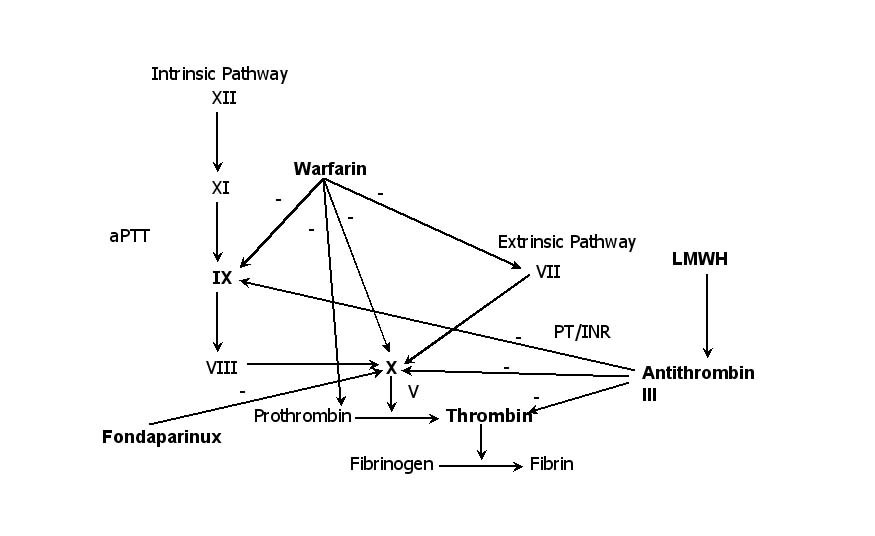
Prothrombin, or factor II, is one of several clotting factors produced by the liver. Prothrombin time (PT) measures the presence and activity of five different blood clotting factors (factors I, II, V, VII, and X). This test measures the integrity of the extrinsic and common pathways of coagulation. The prothrombin time (PT) measures the clotting time from the activation of factor VII through the formation of the fibrin clot. Adequate amounts of vitamin K are needed to produce prothrombin. Warfarin (Coumadin) is sometimes prescribed as a "blood thinner" because it is an effective vitamin K antagonist (blocks the formation of vitamin K).

The activated partial thromboplastin time (PTT) measures the function of several other clotting factors, found in the intrinsic and common blood clotting pathways. It measures the clotting time from the activation of factor XII through the formation of the fibrin clot. PTT prolongations are caused by factor deficiencies (factors VIII, IX, XI, and/or XII), or inhibitors (most commonly, heparin). Heparin prevents clotting by blocking certain factors in the intrinsic pathway.

PTT and activated partial thromboplastin time (aPTT) are basically the same thing. The aPTT has largely replaced the older PTT, which was unable to incorporate variables in surface/contact time: http://www.rnceus.com/coag/coagptt.html

PT is used to monitor treatment with warfarin (Coumadin). Once warfarin is discontinued, it usually takes several days to clear it from the system. The PTT test allows the provider to check that there is enough heparin in the blood to prevent clotting, but not so much as to cause bleeding. Once heparin is discontinued, its blood-thinning effects usually only last a few hours.

The greater the PT/PTT values, the longer it takes the blood to clot. HIGH PT/PTT = risk for BLEEDING. LOW PT/PTT = risk for blood clots/ stroke.

The INR stands for International Normalized Ratio. The INR is calculated from the PT and is intended to allow valid comparisons of results regardless of the type of PT reagent used among different laboratories (INR = [patient PT / mean normal PT]). The INR is a method of standardizing the PT for coumadin anticoagulation. Before the INR, different labs using different reagents had different controls and widely differing PT value ranges.

An INR of 1 means the blood clots "normally" for that pt. The greater the INR, the longer it takes the blood to clot.

The warfarin (Coumadin) dosage for people being treated to prevent the formation of blood clots is usually adjusted so that the prothrombin time is about 1.5 to 2.5 times the normal value (or INR values 2 to 3). A patient may take warfarin to anticoagulate for atrial fibrillation (target INR around 2.5) or for a mechanical heart valve (target INR 3). An INR of 3 means the blood takes about three times as long to clot compared with the normal value for that pt.

Which value, PT or PTT, does heparin influence?

Which one does coumadin?

Stumped?
You can find the right answer by counting to 10:

- - - - - - - - - - = 10

H E P A R I N (7 letters) + 3 (PTT) = 10

C O U M A D I N (8 letters) + 2 (PT) = 10

Here's another one:

What is the antidote for heparin overdose?

Protamine sulfate (just remember P M S)

What is the antidote for too much Coumadin?

Vitamin K (just remember the hard "C" at the beginning of coumadin!)


Top

9 Readers Gave Kudos
 
No. 3
Old Jan 16, 2006, 09:34 AM

Default Re: Can someone explain PTT, aPTT, and INR?
Vicky,
WOW! You are a great educator, thanks so much for your info! This is great!
Top
 
No. 4
Old Jan 16, 2006, 05:00 PM

Default Re: Can someone explain PTT, aPTT, and INR?
Which value, PT or PTT, does heparin influence?

Which one does coumadin?

Stumped?
You can find the right answer by counting to 10:

- - - - - - - - - - = 10

H E P A R I N (7 letters) + 3 (PTT) = 10

C O U M A D I N (8 letters) + 2 (PT) = 10


Wow! Vicky,

I read this sometime this morning...About 2 hours ago I got my HESI study materials in the mail. I popped in the practice test cd and what do you know...one of the first questions was something like "PT would be monitored in patients taking which of the following?" of course Heparin and Coumadin were choices...well, your "COUMADIN + 2" was the answer!

Thanks so much for taking the time to answer so completely!

May
Top
 
No. 5
from VickyRN
Old Jan 16, 2006, 05:29 PM

Default Re: Can someone explain PTT, aPTT, and INR?
Glad to be of assistance
Top
 
No. 6
from rn2bn07
Old Jan 16, 2006, 10:08 PM

Default Re: Can someone explain PTT, aPTT, and INR?
Originally Posted by VickyRN
Glad to be of assistance
Thank you so much for this, I am sure now that I have all of my information and I can't wait to share this with my classmates and my clinical instructor. You went into details, mapped it out and, great efforts to give me a lot of depth about each thing. Thanks again VickyRN and Daytonite
Top
 
No. 7
from blue heron
Old Jan 16, 2006, 10:59 PM

Default Re: Can someone explain PTT, aPTT, and INR?
Thank you for the teaching and the links!!!!!! Awesome.
Top
 
No. 8
Old Jan 17, 2006, 05:42 PM

Default Re: Can someone explain PTT, aPTT, and INR?
thanx for your links
Top
 
No. 9
from pannie
Old Jan 17, 2006, 06:22 PM

Default Re: Can someone explain PTT, aPTT, and INR?
Thanks so much! I've booked marked them and going back to study some more...
Top
 
Page 1 of 2 1 2 >
Reply


Thread Tools


Who's Online
379 members
4,356 guests
4,735

Haiti Disaster Information

1

UK: £100m drive to recruit cancer nurses to work in...

5

Retired nurse survives stormy 17 hours trapped in van

8

$3.9 million gift will attack nursing shortage

17

One-third of RNs Plan to Leave Job in Next 3 Years, Survey...

50

In Texas, a Trial and Possible Prison Time for Reporting a...

10

California Turf War: Anesthesiologists vs. Nurses

34

Bonuses while care deteriorates

5

Using Herpes Virus to Attack Melanoma

12

Dr. Cast New Light on Cat That Predicts Death

6

Tattletale pills, bottles remind you to take your meds


22

On the Edge

11

On the other side of the IV

45

Pregnant in Nursing School....

6

Community-Based Nursing

12

The Patient Nurse

7

Thank You On Behalf Of The General Public

5

Somalia Comes To Me

31

What to say to the parents of special needs children

15

A Lesson well learned "One size does not fit all"

11

Chocolate Heart,

14

Patient Safety: We could be the killer!

137

Dear preceptor

1

Society Needs Care Too

45

Why am I doing this, anyway?

6

Nurse Heal Thyself


Sponsored Links

Currently Reading This Page: 7 (0 members & 7 guests)

Interested in the hottest topics of the week? Subscribe to the Nurse-zine Newsletter.
Enter email address:


New To Site
Need Help
Quick Links

Copyright © 1996-2010, allnurses.com. All rights reserved.  allnurses.com, Inc.
All times are GMT -6. The time now is 11:38 AM.