





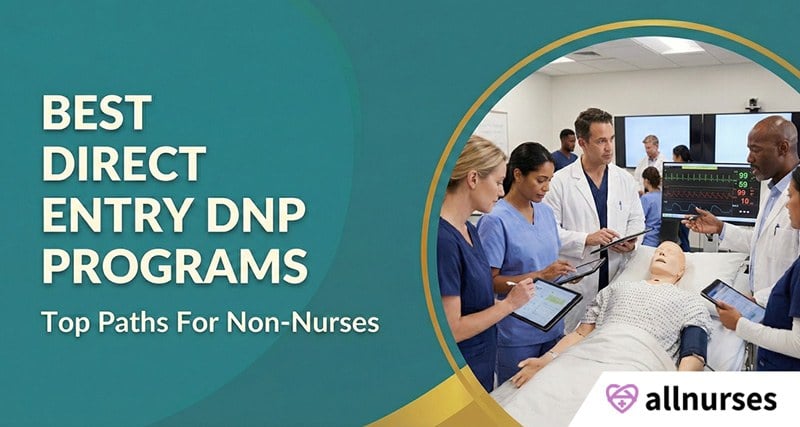
Choosing a Direct Entry DNP program is a high-stakes investment. If your background is in business or psychology, these programs offer a four-year bridge to the highest levels of clinical practice. However, our community notes that the transition is a "brutal" but rewarding deep dive into pharmacology and pathophysiology.
You'll start with foundational coursework, earn your RN license, and seamlessly transition into advanced doctoral training. This guide highlights the top programs for 2026 to help you start your journey.
Quick Glance: Direct Entry DNP Facts
What it is: The fastest path for non-nursing bachelor's degree holders to earn a doctorate in nursing.
Program Duration: Typically 4 years of intensive, full-time study.
Key Steps: Includes pre-licensure coursework to prepare for the NCLEX-RN exam, followed by advanced, graduate-level DNP curriculum.
High Earning Potential: DNP graduates, such as Nurse Anesthetists and Nurse Practitioners, are among the highest earners in the nursing profession.
The Challenge: These programs are academically rigorous and represent a significant financial investment.
Best Direct Entry DNP Programs for Non-Nurses
The following schools were selected based on our methodology of analyzing accreditation status, graduation rates, student-faculty ratio, and overall value.
1. Seattle University
Quick Facts:
Accreditation: Commission on Collegiate Nursing Education (CCNE)
Duration: 4 years, full-time
Pre-Licensure Credits: 67
Cost: $65,191 (for pre-licensure phase)
Program Highlights: While the 20,000-square-foot lab is a draw, Member Insight from our forums suggests students should prepare for observational clinicals early on before moving to hands-on practice.
Specialty Tracks:
Adult-Gerontology Acute Care NP
Family Nurse-Adult Gerontology Primary Care NP
Psychiatric Mental Health NP
Certified Nurse-Midwifery
What Students Are Saying
I would say it is definitely a lot of work, but very rewarding so far. One thing that is surprising is the what we are able to do at clinical sites. It is a lot of observation and less hands on than I was expecting.
by ttop2011. Join the conversation at Seattle University DNP 2020 Cohort (RN or APNI)
2. University of Vermont
Quick Facts:
Accreditation: CCNE
Duration: 4 years, full-time
Total Credits: 106-112.5
Cost: $692/credit (VT resident); $1,200/credit (non-resident)
Program Highlights: Peer feedback highlights the exceptional "student support" and advising, which is critical for those entering nursing from a different career path.
Specialty Tracks:
Adult-Gerontology Nurse Practitioner (AGNP)
Family Nurse Practitioner (FNP)
What Students Are Saying
She spoke really highly of the program. I remember asking specifically about advising and student support, and she assured me that she felt really supported.
by VTSummer. Join the conversation at UVM (vermont) DE-DNP Fall 2022
3. University of Hawaii at Manoa
Quick Facts:
Accreditation: CCNE
Duration: ~4 years, full-time
Total Credits: 123-126
Cost: $1,001/credit (HI resident); $1,896/credit (non-resident)
Program Highlights: The Graduate Entry Program in Nursing (GEPN) is designed for leadership-bound adult learners. Its tri-semester first year is an intensive dive into foundational nursing. After passing the NCLEX-RN, students immediately transition into their graduate specialty track with robust clinical practicums in Hawaii's diverse healthcare settings.
Specialty Tracks:
Family Health NP
Adult-Gerontology Primary Care NP
Psychiatric-Mental Health NP
What Students Are Saying
The content will be brutal. Long days studying studying studying. The two main courses is patho and pharm which was the hardest...speak up now on how to take exams LOL.
by Yessitswess, EMT-B, EMT-P. Join the conversation at University of Hawaii at Manoa GEPN-DNP FALL 2024
4. Boston College
Quick Facts:
Accreditation: CCNE
Duration: ~4 years, full-time
Total Credits: 107
Cost: $1,876/credit
Program Highlights: Located in a world-renowned medical city, Boston College offers exceptional clinical placement diversity. The program is known for cultivating skills in evidence-based practice and health system improvement, preparing graduates for leadership roles in prestigious institutions.
Specialty Tracks:
Adult-Gerontology Primary Care NP
Family Health NP
Pediatric Primary Care NP
Psychiatric-Mental Health NP
Women's Health NP
What Students Are Saying
Boston College accepts online classes and it's very affordable... BC you can choose to stop after your RN, there's more flexibility! BC is an amazing place!
by futurenp8810. Join the conversation at Boston Direct Entry Masters and DNP 2020
5. University of Washington
Quick Facts:
Accreditation: CCNE
Duration: 4 years, full-time (13 quarters)
Total Credits: 172
Cost: $11,688/quarter (WA resident); $16,679/quarter (non-resident)
Program Highlights: This program offers a unique path with early admission to its esteemed Nurse-Midwifery DNP track after completing the ABSN portion. With over 700 clinical partners, including Seattle Children's Hospital and UW Medical Center, students receive unparalleled hands-on experience.
Specialty Tracks:
Nurse-Midwifery
What is a Direct Entry DNP Program?
A Direct Entry Doctor of Nursing Practice (DNP) program is an accelerated academic track for individuals who hold a bachelor's degree in a non-nursing field. It allows you to become a Registered Nurse (RN) and earn a DNP—the highest degree for clinical nursing practice—within a single, continuous program, bypassing the need for a separate Bachelor of Science in Nursing (BSN).
Cost at a Glance: 2026 Top Direct-Entry DNP Programs
| University | State | Cost Per Credit | Tuition* |
|---|---|---|---|
| University of Vermont | VT | $692 | ~$46,364 |
| University of Hawaiʻi at Mānoa | HI | $1,001 | Varies |
| Seattle University | WA | ~$973 | $65,191 |
| Boston College | MA | $1,876 | ~$108,808 (for MSN portion) |
| University of Washington | WA | ~$3,896 (per quarter) | ~$46,752 (for ABSN portion) |
*This table compares the initial, pre-licensure phase costs where available. Total program cost will be significantly higher. Costs are estimates.
Program Costs & Financial Aid
Direct Entry DNP programs are a major financial commitment. Costs vary widely based on the institution (public vs. private) and residency status. You should budget for:
Tuition and Fees: Can range from $80,000 to over $200,000 for the entire program.
Books and Supplies: Textbooks, lab coats, and medical instruments add up.
Living Expenses: Housing, food, and transportation, especially during intensive clinical rotations.
Certification and Licensure: Fees for the NCLEX-RN and your final APRN certification exams.
To manage these costs, explore financial aid options. Our guide on how to pay for nursing school provides detailed information on scholarships, grants, and loan forgiveness programs.
Realistic ROI: Salary Potential & Career Growth
While the financial commitment of a Direct Entry DNP—often ranging from $80,000 to over $200,000—is significant, the "Total Career Value" is validated by the speed of entry into high-level provider roles. By bypassing the years spent in a traditional BSN-to-MSN-to-DNP track, you enter the workforce as a doctoral-prepared provider much sooner.
The return on investment is supported by substantial salary potential and record-breaking demand. According to the latest BLS reports, median annual salaries for these roles include:
Nurse Anesthetists: $231,700+
Nurse Practitioners: $132,000+
Nurse Administrators: $134,440+
Beyond the immediate salary, the job growth projection for APRNs is 35% through 2034. For career changers, this represents not just a new job, but a high-floor, high-ceiling transition into one of the most stable sectors of the economy.
Admission Requirements for Non-Nurses
While you don't need a nursing degree, programs have strict prerequisites to ensure you're prepared for the rigorous curriculum. Common requirements include:
Bachelor's Degree: From an accredited institution in any non-nursing field.
Minimum GPA: Typically 3.0 or higher.
Prerequisite Courses:
Anatomy & Physiology I & II (with labs)
Microbiology (with lab)
Chemistry
Statistics
Application Materials: A completed application, official transcripts, letters of recommendation, a compelling personal statement, and a professional resume/CV.
Healthcare Experience: Some programs require or strongly prefer volunteer or paid experience in a healthcare setting.
DNP Curriculum and Clinical Training
The curriculum is divided into two main phases:
Pre-Licensure Phase (Year 1): This intensive phase covers foundational nursing skills, anatomy, pharmacology, and pathophysiology to prepare you for the NCLEX-RN licensure exam.
Graduate DNP Phase (Years 2-4): You will dive into advanced practice coursework in your chosen specialty, evidence-based practice, healthcare policy, and leadership.
Clinical training is a cornerstone of the DNP. You will complete over 1,000 post-baccalaureate clinical hours, as required by the AACN, in settings like primary care clinics, hospitals, and specialty practices.
Pros and Cons of a Direct Entry DNP
| Advantages | Disadvantages |
|---|---|
| Accelerated path to advanced practice: One of the fastest routes to a terminal nursing degree. | Highly intensive: Coursework and clinicals require a full-time commitment. |
| High earning potential: Prepares graduates for senior clinical and leadership roles. | Significant cost: Tuition and time out of the workforce can be substantial. |
| Comprehensive education: Covers RN foundations, advanced practice, and leadership training. | Limited bedside experience: Less time practicing as an RN before entering advanced roles. |
| Strong demand: DNP-prepared nurses help fill leadership and provider gaps. | Burnout risk: The pace and expectations can be stressful for some students. |
Is a Direct Entry DNP Program Worth It?
A Direct Entry DNP is worth it for highly motivated, academically strong individuals who are certain about their goal to become an advanced practice nurse. It provides an efficient, albeit challenging, path to a rewarding and high-paying career. However, if you are unsure about your specialty or prefer to gain several years of bedside nursing experience first, a traditional path may be a better fit. Carefully weigh the intensity and cost against the long-term career benefits.
Watch: Are DNP Programs Worth It?
Frequently Asked Questions (FAQ)
How do I choose the best Direct Entry DNP program?
Can I work while enrolled in a Direct Entry DNP program?
It is extremely difficult and often prohibited. The pre-licensure year is especially intensive, and most programs, like those for Nurse Anesthetists, explicitly forbid students from working due to the demanding academic and clinical schedule.
Is a Direct Entry DNP faster than traditional pathways?
Yes. A Direct Entry DNP typically takes 4 years. A traditional route (4-year BSN + 2 years work experience + 3-4 year DNP program) could take 9+ years.
Do employers respect graduates of Direct Entry DNP programs?
Yes. These programs are rigorously accredited and produce highly qualified graduates. While some managers may prefer nurses with more years of bedside experience, graduates are fully prepared and licensed for advanced practice roles and are respected for their strong academic foundation.
What specialties can I pursue?
Common specialties include Family Nurse Practitioner (FNP), Psychiatric-Mental Health Nurse Practitioner (PMHNP), Adult-Gerontology Acute or Primary Care NP (AGACNP/AGPCNP), and Nurse-Midwifery.