






Texas ABSN Standouts
Texas A&M University: Best Overall (Great ROI)
Texas Tech University HSC: Best Value (Lowest Tuition: ~$14k)
Baylor University: Fastest Program (Online, 12 Months)
UT Health Houston: Best Clinicals (900+ Clinical Hours)
UT Arlington: Best Online Flexibility (Multiple start dates)
Cheapest Accelerated BSN Programs in Texas
Cost is a major factor for second-degree students. Below is a ranking of the estimated in-state tuition for the top programs on our list.
Estimated Program Tuition (In-State)
| School | Tuition |
|---|---|
| Texas Tech University HSC | $14,030 |
| UT Health Houston | $17,460 |
| UT Health San Antonio | $19,440 |
| UT Rio Grande Valley | $20,007 |
| UT Arlington | $21,675 |
| Texas A&M University | $23,069 |
| University of Houston | $29,040 |
| Baylor University | $68,076 |
| Texas Christian University (TCU) | $134,810 |
Texas ABSN Programs: A Detailed Review
Building on the details shared above, this section highlights key program features, admission requirements, and other essential information to help guide your decision-making. Discover what sets these ABSN programs in the Lone Star State apart as you prepare for your nursing career.
Check the section above for details on tuition, accreditation, program formats, ranking criteria, and more.
1. Texas A&M University, College Station
BEST ROI
Kicking off our list is the Texas A&M College of Nursing. This 15-month program is renowned for its academic rigor and exceptionally high board pass rates. It combines in-class instruction, simulation, and clinical experiences.
Program Length: 15 Months
Estimated Tuition: $23,069
NCLEX-RN Pass Rate: 99%
Pros & Cons
Pros: Outstanding 99% NCLEX pass rate; prestigious reputation.
Cons: Highly competitive admission; strict application windows.
Admission Requirements:
Bachelor's degree in a non-nursing field.
HESI or TEAS exam required.
Cumulative 3.3 GPA on science prerequisites.
Application Deadlines:
Fall Admission: January 15
Spring Admission: August 1
2. University of Texas Health Science Center, San Antonio
BEST VALUE
UT Health San Antonio offers a robust 15-month program. It is a full-time, in-person commitment that utilizes state-of-the-art simulation labs.
Program Length: 15 Months
Estimated Tuition: $19,440
NCLEX-RN Pass Rate: 94.79%
Pros & Cons
Pros: Affordable tuition (<$20k); over 100 nursing scholarships available.
Cons: Full-time strict schedule makes working difficult.
Admission Requirements:
Non-nursing Bachelor's degree.
Completion of 51 of 60 prerequisite hours before applying.
3.0 GPA on prerequisites.
Application Deadlines:
Summer Admission: January 2
3. University of Texas Health Science Center, Houston
Known as the "Pacesetter" BSN, this program from the Cizik School of Nursing is intense and clinically rich. Students complete 900 clinical hours, which is higher than many competitors, providing superior hands-on preparation.
Program Length: 15 Months
Estimated Tuition: $17,460
NCLEX-RN Pass Rate: 95.58%
Pros & Cons
Pros: Very low cost; massive amount of clinical experience (900 hours).
Cons: The "Pacesetter" curriculum is extremely fast-paced and demanding.
Admission Requirements:
HESI or TEAS exam required.
Minimum GPA on science prerequisites.
Application Deadlines:
Fall Admission: March 15
Spring Admission: September 15
Summer Admission: February 1
4. University of Houston
BEST NCLEX RATE
The Andy & Barbara Gessner College of Nursing offers a 12-month intensive option (one of the faster on-campus options available). Note: This program boasts a stellar 100% pass rate in recent cohorts.
Program Length: 12 Months
Estimated Tuition: $29,040
NCLEX-RN Pass Rate: 100%
Pros & Cons
Pros: Flawless NCLEX pass rate (100%); fast 12-month completion.
Cons: Higher tuition than public competitors like Texas Tech or A&M.
Admission Requirements:
ATI TEAS Exam completion.
3.0 cumulative GPA.
Application Deadlines:
Spring Admission: July 15
5. Baylor University
Baylor offers a "Distance ABSN" which allows students to complete coursework online and clinicals locally in Texas. It is grounded in a Christian worldview.
Program Length: 12 Months
Estimated Tuition: $68,076
NCLEX-RN Pass Rate: 94.49%
Pros & Cons
Pros: Extremely fast (1 year); high flexibility with online coursework.
Cons: Significantly more expensive than public universities.
6. Texas Tech University Health Sciences Center
TTUHSC offers the most affordable program on our list. It is a 12-month program that combines online theory with clinical coaching at sites across Texas (Abilene, Austin, Dallas, etc.).
Program Length: 12 Months
Estimated Tuition: $14,030
NCLEX-RN Pass Rate: 93.08%
Pros & Cons
Pros: Best financial value in Texas; 12-month completion.
Cons: Online format requires high self-motivation; Spring-only admission.
Admission Requirements:
Non-nursing bachelor's degree from an accredited school
Minimum cumulative GPA: 2.5
55 credit hours of general education courses completed
Three of five required science prerequisites completed
Prerequisite coursework: Pathophysiology, Microbiology, Anatomy and Physiology I & II, Chemistry
CNA training preferred
American Heart Association Basic Life Support Certification (AHA BLS)
Application Deadlines:
Spring Admission: July 15
7. The University of Texas at Arlington
UTA offers a 51-credit-hour program with a "Academic Partnership" model, making it very accessible for students across the DFW area and beyond.
Program Length: 15 Months
Estimated Tuition: $21,675
NCLEX-RN Pass Rate: 94.17%
Pros & Cons
Pros: Large network of clinical sites; flexible online course structure.
Cons: Pass rate is slightly lower than A&M or Baylor (though still solid).
Admission Requirements:
Bachelor's degree or a minimum of 24 credit hours
16 credit hours of natural sciences completed
Minimum Cumulative GPA: 2.75
Prerequisite Courses: Grade "C" or better
TEAS exam score: 59%-77%
Application Deadlines:
Fall Admission: January 15
Spring Admission: June 1
8. University of Texas Rio Grande Valley
UTRGV provides a vital pathway for students in the Rio Grande Valley. It is slightly longer (24 months) than typical ABSN programs, which may allow for better work-life balance.
Program Length: 15-24 Months
Estimated Tuition: $20,007
NCLEX-RN Pass Rate: 92.14%
Pros & Cons
Pros: Slower pace (24 months) may be less stressful than 12-month options.
Cons: Takes twice as long to enter the workforce as Baylor or Texas Tech.
Admission Requirements:
Non-nursing bachelor's degree
Minimum Cumulative GPA: 3.0
Prerequisite Coursework: Biology, Sociology, Microbiology, Chemistry, Psychology, Developmental Psychology, Nutrition, Medical Terminology
Prerequisite Courses: Grade "C" or better
6 credit hours of United States History and Government or Political science
HESI A2 Exam: Score of 75%
Pass a math quiz with a 100% grade
Current AHA BLS certification
Immunization record
Application Deadlines:
Fall Admission: January 31
Spring Admission: June 30
Summer Admission: October 31
8. Texas Christian University
BEST NCLEX RATE
TCU offers a premium nursing education experience with small class sizes and excellent resources, though it comes with a private school price tag.
Program Length: 20 Months
Estimated Tuition: $134,810
NCLEX-RN Pass Rate: 100%
Pros & Cons
Pros: Prestigious faculty; small class sizes; excellent facilities.
Cons: Highest cost on the list by a significant margin.
Admission Requirements:
A previous bachelor's degree
Minimum cumulative GPA of 3.0
Prerequisite coursework
ATI TEAS Exam completed
Application Deadlines:
June Admission: February 1
Understanding Accelerated BSN Programs in Texas
What Is an ABSN Program?
An Accelerated BSN is a second-degree nursing program designed for individuals who have already earned a bachelor's degree in another field. It condenses the coursework of a traditional four-year BSN into an intensive 12-24 month curriculum, building upon your existing college credits.
Common Coursework and Clinical Requirements
ABSN programs in Texas cover the same core material as traditional programs, including:
Foundational Sciences: Anatomy, Pathophysiology, Microbiology, Pharmacology.
Nursing Theory & Skills: Patient assessment, medication administration, evidence-based practice, and wound care.
Specialized Areas: Pediatrics, acute/critical care, psychiatric nursing, and community health.
Clinical Rotations: All programs require extensive, in-person clinical hours at hospitals, clinics, and other healthcare facilities in Texas. While coursework may be online, clinicals are mandatory and hands-on.
Can ABSN Programs in Texas Be Taken Entirely Online?
While some components of an ABSN program, such as theoretical coursework, may be available online, the program cannot be completed entirely online. ABSN programs require hands-on clinical training and lab work, which must be completed in person. These in-person experiences are essential for developing the practical skills needed for nursing and are a key component of the program's curriculum. Therefore, while online elements can offer flexibility, expect to attend on-site sessions for clinical rotations and lab activities.
Typical Admission Requirements
Previous Degree: A bachelor's degree in a non-nursing field from an accredited institution.
Prerequisites: Completion of specific science and general education courses (e.g., Anatomy & Physiology, Chemistry, Statistics) with a minimum GPA, often 3.0 or higher.
Entrance Exam: A satisfactory score on an entrance exam like the HESI A2 or TEAS.
How Much Do Nurses Earn in Texas?
According to the latest data from the U.S. Bureau of Labor Statistics, RNs earn:
- Mean Hourly Wage: $45.42
- Mean Annual Wage: $94,480.00
RNs in the bottom 10% of the pay scale earn around $63,720 while RNs in the top 10% of the pay scale earn around $132,680 annually.
Top Paying States for RNs
- California: $137,690.00
- Hawaii: $119,710.00
- Massachusetts: $113,440.00
- Oregon: $111,030.00
- Alaska: $109,210.00
Average ADN RN Salary:
Typically, there is a noticeable income gap between nurses with an associate degree (ADN) compared to those with a bachelor's degree, with BSN RNs generally earning higher salaries. However, the BLS does not differentiate between these educational levels in its salary reports. Using data from ZipRecruiter, we can identify the salary differences betweenADN RNs and BSN RNs.
- Hourly Wage: $39.00
- Annual Wage: $80,321.00
Average BSN RN Salary:
- Hourly Wage: $46.00
- Annual Wage: $96,546.00
By understanding these factors and differences in nursing salaries, you can make informed decisions about your nursing education and career to maximize your earning potential.
Financial Aid for Your Texas ABSN
Texas offers various funding sources to help offset the costs of ABSN programs, including federal, state, employer, and institutional opportunities.
Federal & State
Free Application for Federal Student Aid (FAFSA) Required for federal aid and most school aid; TASFA for eligible Texas residents who can't file FAFSA.
HRSA Nurse Corps Scholarship: Can cover tuition/fees + stipend for BSN students in exchange for service at eligible facilities after graduation.
Texas College Access Loan (CAL): State, low-interest, credit-based loan for Texas residents at Texas schools; can bridge gaps.
Texas Public Educational Grant (TPEG): Campus-based need grant administered by each institution (first-come, limited funds).
Institutional
Merit- and need-based scholarships: Many colleges offer nursing-specific awards; apply early and reapply annually.
Work-Study placements/student employment: Simulation lab, library, or departmental roles tied to FAFSA eligibility.
Employer (While You Study or After You're Hired)
Tuition reimbursement/tuition discounts: Hospital partnerships often reimburse approved coursework with a post-grad service commitment.
Importance of Picking an Accredited ABSN Program in Texas
Choosing an accredited ABSN program in Texas is crucial for several reasons:
Ensures Quality Education: Accreditation signifies that the program meets established standards of quality in nursing education, ensuring you receive a robust and comprehensive education that prepares you for the nursing profession.
Eligibility for Licensure: Graduating from an accredited ABSN program is often a requirement to sit for the NCLEX-RN exam, which is necessary to obtain your nursing license and practice as a registered nurse.
Transferability of Credits: If you decide to further your education, credits from an accredited program are more likely to be accepted by other institutions, making it easier to pursue advanced degrees in nursing.
Employment Opportunities: Employers often prefer or require nurses to have graduated from accredited programs, as it assures them that the candidate has received a quality education and is well-prepared for the demands of the job.
Access to Financial Aid: Many forms of federal and state financial aid, as well as scholarships, are only available to students enrolled in accredited programs, making it easier to finance your education.
Accrediting bodies include the Commission on Collegiate Nursing Education (CCNE) and the Accreditation Commission for Education in Nursing (ACEN).
ABSN Programs Near Me
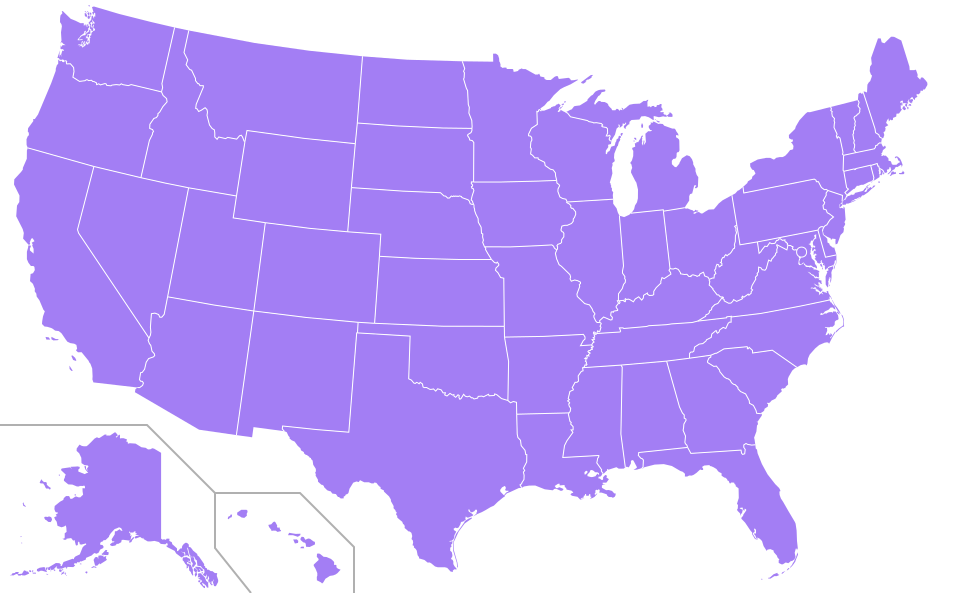
Discover the best ABSN programs in the following states:
Visual Guide: Top Texas ABSN Programs
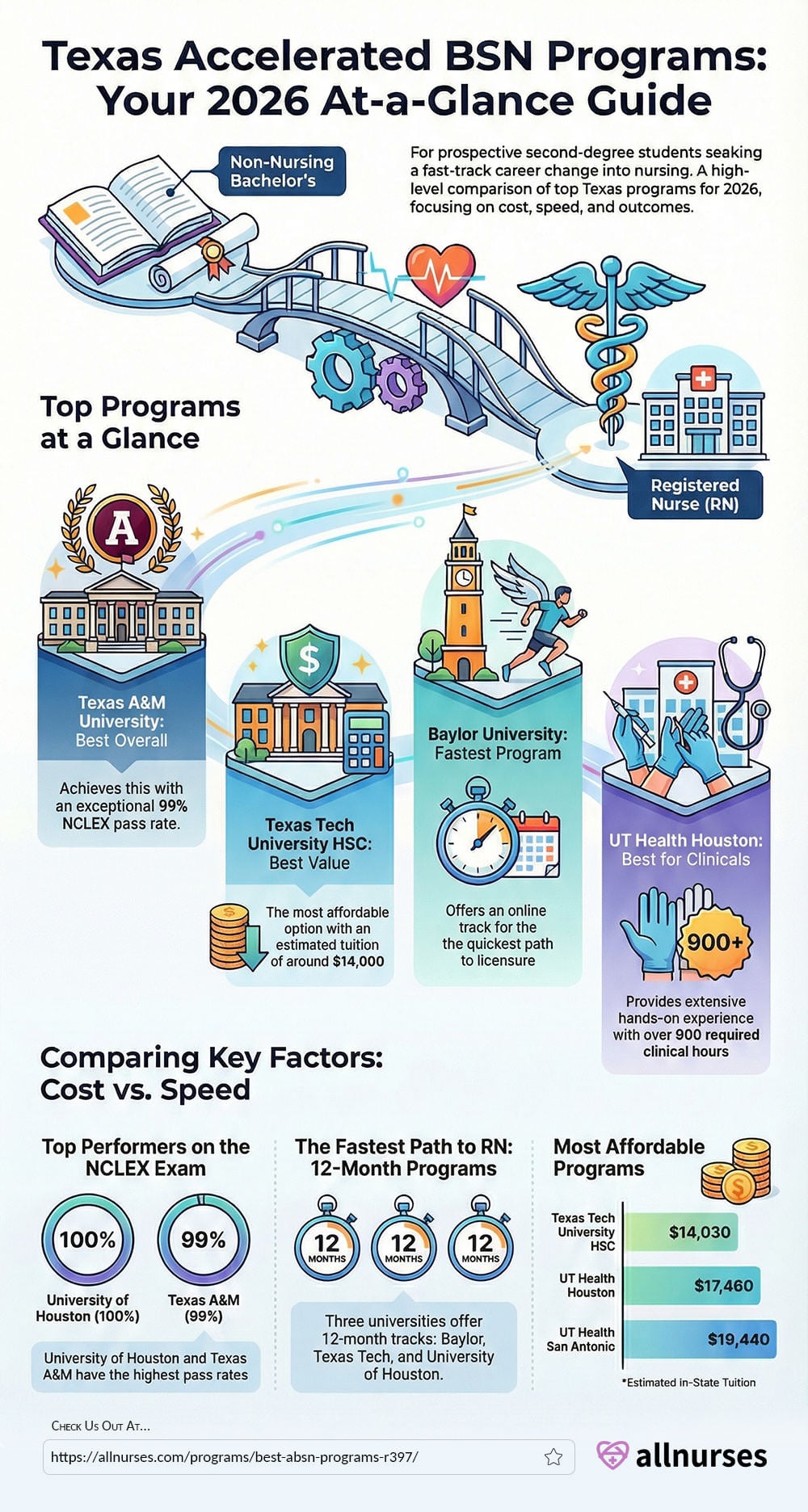

Use this graphic on your site:
Frequently Asked Questions (FAQ)
What is the fastest ABSN program in Texas?
Baylor University, Texas Tech (TTUHSC), and the University of Houston all offer 12-month programs, which is the fastest route to licensure.
Can I work while enrolled in an ABSN program?
It is generally not recommended. Programs like the "Pacesetter" at UT Health Houston or the 12-month tracks are extremely rigorous. If you must work, consider the 24-month track at UT Rio Grande Valley.
Is an online ABSN valid?
Yes. Programs like Baylor and UT Arlington offer online coursework, but you must still complete in-person clinical rotations at a partner hospital in Texas.
What is the cheapest ABSN in Texas?
Texas Tech University Health Sciences Center is currently the most affordable, with estimated in-state tuition around $14,030.