





Key Takeaways: Top California ABSN Programs
Here is a quick summary of the top 6 programs to help you find your best fit immediately.
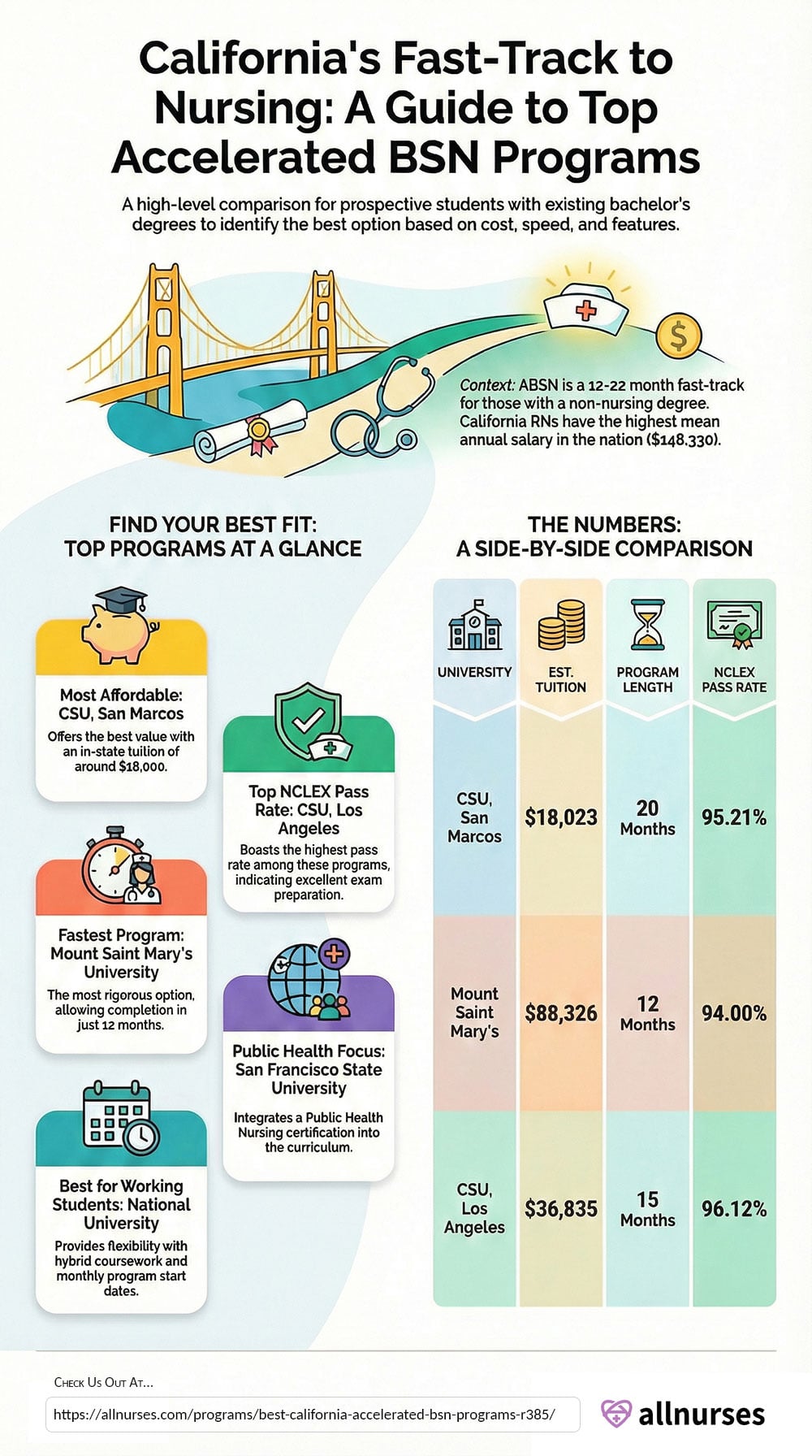
California State University, San Marcos — Most affordable at in-state tuition ($18k) with high (95%+) NCLEX pass rate.
Mount Saint Mary's University — Fastest completion time (12 months) located in Los Angeles.
National University — Best for working students offering hybrid coursework and monthly start dates.
Samuel Merritt University — Highest graduation rate (97%) with extensive clinical placement networks.
San Francisco State University — Top choice for Bay Area students focusing on public health and community nursing.
California State University, Los Angeles — Highest NCLEX pass rate (96.12%) among ranked public schools.
Cheapest Accelerated BSN Programs in California
Cost is a major factor for second-degree students. While private universities offer speed, California State University (CSU) campuses often provide the best ROI.
Estimated Tuition Costs
| School | Tuition |
|---|---|
| California State University, San Marcos | $18,023 |
| California State University, Los Angeles | $36,835 |
| San Francisco State University | $44,744 |
| National University | $73,260 |
| Mount Saint Mary's University | $88,326 |
| Samuel Merritt University | $98,020 |
Note: Costs are estimated for tuition only. Visit school Financial Aid Programs for scholarship opportunities.
Best Accelerated BSN Programs in California
Below is a deeper look into what makes these programs stand out beyond the numbers.
California State University, San Marcos
BEST VALUE — CSU-San Marcos offers a robust 5-semester program. It is ideal for students who want a "bootcamp" style education without the private school price tag.
Pros: Very affordable; High NCLEX pass rate.
Cons: Highly competitive points-based admission.
CSUSM (San Marcos) ABSN Admission Requirements:
Credit/Unit Hours: 67
Minimum GPA: 2.5
Admission Tip: Admission is points-based. Maximize your TEAS score (71+) and GPA (2.5+) in the "Pre-Nursing Core" classes to remain competitive.
Financial Aid: Eligible for the Sylvia Chavez Memorial Scholarship.
Mount Saint Mary's University
⚡ FASTEST — Located in the heart of LA, MSMU is known for its rigorous 12-month pace. This program is for students who can commit 100% of their time to study—working during this program is strongly discouraged.
Pros: Fastest completion time (1 year); Rotations occur at top-tier LA hospitals, providing networking opportunities for post-grad jobs.
Cons: Expensive tuition.
MSMU (Los Angeles) ABSN Admission Requirements:
Minimum GPA: 3.0
Completion of all prerequisite courses with a grade of "C" or higher
National University
National offers a distinct "one course per month" format. This allows students to focus intensely on one subject at a time. It is a veteran-founded, military-friendly institution.
Pros: Flexible start dates (monthly); More accessible GPA requirements.
Cons: Lower NCLEX pass rate (87.78%) compared to CSUs.
NU (San Diego) ABSN Admission Requirements:
Credit/Unit Hours: 45 minimum (varies on transferred credits)
Completion of all prerequisite courses with a "C" grade or higher
Minimum GPA: 2.75
Cumulative GPA of at least 3.00 for last 60 semester units
Samuel Merritt University
SMU is a health-sciences-only university, meaning the entire campus culture is dedicated to healthcare.
Pros: Excellent job placement; High graduation support.
Cons: Highest cost on this list; Recent NCLEX dip (79.25%).
SMU (Oakland) ABSN Admission Requirements:
Credit/Unit Hours: 76
Prerequisite Courses: Anatomy & Physiology, Microbiology, Chemistry, Pharmacology, Statistics, Psychology
San Francisco State University
SFSU is a heavyweight in the Bay Area. The program is unique because it integrates Public Health certification into the curriculum, saving you time later if you wish to pursue community nursing.
Pros: Graduates eligible for Public Health Nursing cert; Strong community focus.
Cons: Extremely competitive admission (approx. 16% acceptance).
SFSU (San Francisco) ABSN Admission Requirements:
Credit Hours: 56
Minimum GPA: 3.0
ATI TEAS Score: 78 or higher
Prerequisite Coursework: Anatomy & Physiology, Chemistry, Microbiology, Communication, Statistics
Prerequisite Coursework: Grade of "C" or higher
Personal Statement
SFSU Application Deadlines: September 2
California State University, Los Angeles
Cal State LA emphasizes cultural competency and service. The 15-month timeline is slightly longer than others, which allows for a more manageable pace while still being "accelerated."
Pros: Excellent balance of cost vs. quality; 96% NCLEX rate.
Cons: Only one cohort per year (Summer start).
Cal State LA ABSN Admission Requirements:
Credit/Unit Hours: 53-semester units
Minimum GPA: 3.0
Prerequisite Coursework: Anatomy and Physiology, Microbiology, Chemistry, Statistics, Critical Thinking
Prerequisite Coursework: Grade of "B" in all science courses
Prerequisite Coursework: Grade "C" in all other prerequisite courses
ATI TEAS Score: 70 or higher
What Is an ABSN Program?
An Accelerated Bachelor of Science in Nursing (ABSN) is a fast-track pathway for non-nurses who already hold a bachelor's degree in a field (such as Psychology, Biology, or Arts).
Unlike a traditional 4-year BSN, California ABSN programs focus exclusively on nursing coursework and clinical rotations. Because general education credits are transferred from your previous degree, you can become an RN in 12 to 15 months.
Admission Requirements & Prerequisites
Before applying, ensure you meet the standard criteria for California ABSN tracks:
Bachelor's Degree: From an accredited institution (non-nursing).
Core Science Prerequisites: Anatomy, Physiology, Microbiology, and Chemistry (often with a 5-7 year recency limit).
General Prerequisites: Statistics, Psychology, and Oral Communication.
GPA: Typically a minimum of 2.5 to 3.0, though competitive programs often require a 3.5+.
Entrance Exams: Most programs require the TEAS 7 exam.
ABSN Salary Expectations
According to the latest data from the U.S. Bureau of Labor Statistics, registered nurses in California earn:
- Mean Hourly Wage: $71.31
- Mean Annual Wage: $148,330
RNs in the bottom 10% of the pay scale earn around $100,120 while RNs in the top 10% of the pay scale earn around $208,880 annually.

Use this graphic on your site:
Frequently Asked Questions
Are online ABSN programs in California available?
Why choose an ABSN in California?
- Speed: Enter the workforce 2+ years sooner than a traditional student.
- Salary: California RNs earn the highest average salary in the nation ($133,000+), making the ROI on an accelerated degree exceptionally high.
- Competitiveness: These programs are intense. You will typically complete the same number of clinical hours as a traditional student, compressed into a full-time, year-round schedule.