




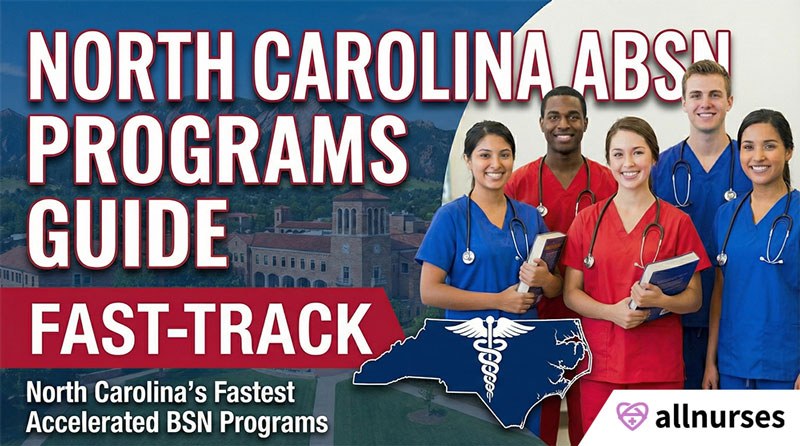
If you are interested in the best Accelerated Bachelor of Science in Nursing (ABSN) programs in North Carolina, you have come to the right place. North Carolina is facing a significant demand for registered nurses, and for those with a non-nursing bachelor's degree, an ABSN is the fastest route to licensure.
This comprehensive guide ranks the top programs for 2026 based on academic quality, affordability, and student outcomes. We also explore essential 2026 data on coursework, clinical training within NC health systems, costs, and salary expectations. For verification of licensure requirements, always consult the North Carolina Board of Nursing (NCBON).
Quick Glance: Top NC ABSN Picks
Best Overall: University of North Carolina at Chapel Hill
Best Value (Public): Western Carolina University & East Carolina University
Fastest Completion: Queens University of Charlotte (12 Months)
Best Private Program: Duke University
Best for Clinical Placements: Cabarrus College (Atrium Health affiliation)
Best ABSN Programs in North Carolina - Online & On-Campus
Why trust us?
Our ranking methodology blends data from the U.S. Department of Education with the experiences and insights of the allnurses community. We prioritize accredited programs with transparent NCLEX pass rates and student satisfaction.
1. University of North Carolina at Chapel Hill
Location: Chapel Hill, NC
allnurses School Ranking: A+ / 98
Topping our list of NC ABSN programs is UNC-Chapel Hill's ABSN program. It offers dedicated faculty, robust research opportunities, and a curriculum emphasizing interprofessional education. Like most ABSN programs, learning is in-person on campus, and the program is completed in just four semesters.
Program Format: On-Campus
Tuition: ~$17,520
RN Pass Rate: 96.35%
Program Length: ~16 Months
Why it stands out: UNC offers world-class clinical rotations at UNC Medical Center and a highly competitive in-state tuition rate, providing excellent ROI.
View UNC at Chapel Hill School Profile
2. Western Carolina University
Location: Cullowhee, NC (Instructional site in Asheville)
allnurses School Ranking: A / 91
Runner-up in NC is the WCU School of Nursing Accelerated BSN program, offering 16 months of in-person learning at the Biltmore Park instructional site in Asheville, NC. The program includes clinical rotations in acute, restorative, and community-based settings, primarily in Buncombe County and Western NC.
Program Format: On-Campus
Tuition: ~$14,364
RN Pass Rate: 99%
Program Length: ~16 Months
Why it stands out: Western Carolina consistently delivers 100% NCLEX pass rates and offers one of the most affordable tuition structures in the region.
View Western Carolina University School Profile
3. Duke University
Location: Durham, NC
allnurses School Ranking: B+ / 89
Unsurprisingly, another top-ranking Accelerated BSN program in North Carolina is offered by Duke University School of Nursing. Duke's ABSN program is distinguished by its rigorous curriculum, extensive clinical training, and focus on developing highly skilled, compassionate nurses. The program features expert faculty and high-fidelity simulation labs.
Program Format: On-Campus
Tuition: ~$105,444
RN Pass Rate: 91%
Program Length: ~16 Months
Why it stands out: Duke provides unrivaled access to the Duke University Health System and focuses on leadership and Global Health, though at a higher private tuition point.
View Duke University School Profile
4. Queens University of Charlotte
Location: Charlotte, NC
allnurses School Ranking: B+ / 89
The Presbyterian School of Nursing at Queens University in Charlotte offers a highly regarded ABSN program. This accelerated program enables students to complete a second degree in nursing in just 12 months over three semesters. With strong partnerships with leading healthcare providers, Queens ensures students access exceptional clinical placement opportunities.
Program Format: On-Campus
Tuition: ~$72,102
RN Pass Rate: 89%
Program Length: ~12 Months
Why it stands out: This is one of the fastest routes to licensure in the state (12 months), located directly in the healthcare hub of Charlotte.
View Queens University of Charlotte School Profile
5. University of North Carolina, Wilmington
Location: Wilmington, NC
allnurses School Ranking: B+ / 89
The ABSN program at UNC-Wilmington is a fast-track program designed for students who have an existing bachelor's degree and want to transition into the nursing field. This program is an intensive on-campus course. Students benefit from experienced faculty, an advanced Simulation Learning Center, and access to the Student Success Center.
Program Format: On-Campus
Tuition: ~$17,864
RN Pass Rate: 90%
Program Length: ~16 Months
Why it stands out: UNCW combines coastal living with rigorous academics and a strong reputation for producing nurses ready for the southeast regional market.
View University of North Carolina, Wilmington School Profile
6. East Carolina University
Location: Greenville, NC
allnurses School Ranking: B+ / 88
The College of Nursing at ECU offers one of the top-ranking ABSN programs in NC. This rigorous, full-time, in-person program is designed to be completed in just 12 months, providing students with a comprehensive foundation for a nursing career.
Program Format: On-Campus
Tuition: ~$12,200
RN Pass Rate: 96%
Program Length: ~12 Months
Why it stands out: ECU offers an incredible value proposition: highly affordable in-state tuition combined with a rapid 12-month curriculum.
7. Fayetteville State University
Location: Fayetteville, NC
allnurses School Ranking: B+ / 87
The Lloyd College of Health, Science, and Technology at FSU offers another excellent ABSN program in NC. The program features a hybrid learning model, combining online and face-to-face coursework with essential in-person clinical practice. Students benefit from expert faculty mentorship and state-of-the-art simulation technology.
Program Format: Hybrid
Tuition: ~$11,895
RN Pass Rate: 85%
Program Length: ~16 Months
Why it stands out: FSU's hybrid format offers slight flexibility while maintaining a very low cost of attendance, making it accessible for many students.
8. Gardner-Webb University
Location: Boiling Springs, NC
allnurses School Ranking: B+ / 86
The Accelerated BSN program at GWU is a top choice in NC, designed to help students transition into nursing while developing skills to ensure success as a registered nurse. This program boasts comprehensive coursework covering clinical expertise, therapeutic relationships, and applying Christian values to nursing.
Program Format: On-Campus
Tuition: ~$31,200
RN Pass Rate: 83%
Program Length: ~16 Months
Why it stands out: A faith-based institution with a perfect 100% NCLEX pass rate record in recent cohorts, ensuring high educational standards.
9. Cabarrus College of Health Sciences
Location: Concord, NC
allnurses School Ranking: B+ / 86
The ABSN program at Cabarrus College of Health Sciences provides immersive learning on a hospital-based campus affiliated with Atrium Health, ensuring preferred access to clinical sites. With small class sizes and personalized support, this program offers a flexible path to a nursing degree.
Program Format: On-Campus
Tuition: ~$44,520
RN Pass Rate: 81%
Program Length: ~16 Months
Why it stands out: Being hospital-based within the Atrium Health network provides students with seamless clinical placements and networking opportunities.
10. University of North Carolina at Charlotte
Location: Charlotte, NC
allnurses School Ranking: B / 85
The BSN Accelerated option at UNC Charlotte provides an affordable, efficient, and comprehensive path for bachelors-prepared students. This program features high-fidelity simulation in the Advanced Learning Center and dedicated support from quality tutors.
Program Format: On-Campus
Tuition: ~$7,783
RN Pass Rate: 97%
Program Length: ~16 Months
Why it stands out: A strong public option in the state's largest city, UNC Charlotte boasts a 100% pass rate and robust local clinical connections.
View UNC Charlotte School Profile
11. South College
Location: Asheville, NC
allnurses School Ranking: B / 85
Rounding off the top ABSN programs in NC is South College's ABSN program at the Asheville campus. This program provides students with a solid academic and clinical foundation to excel as nurse generalists.
Program Format: On-Campus
Tuition: ~$33,480
RN Pass Rate: 89%
Program Length: ~18 Months
Why it stands out: Offers a slightly longer timeline (18 months) which may benefit students who need a pace slightly less intense than the 12-month options.
View South College School Profile
What Is an ABSN Program?
In an accelerated nursing program, you will engage in an intensive, fast-paced curriculum that covers the same comprehensive material as a traditional BSN program but in a condensed timeframe. The coursework is challenging, yet it is designed to quickly and thoroughly prepare you for a nursing career by building on your existing knowledge in the sciences and humanities.
ABSN Coursework in North Carolina
ABSN coursework in North Carolina typically includes:
Foundational Sciences: Anatomy, Pathophysiology, Microbiology, and Chemistry.
Pharmacology: Principles of drug classifications and mechanisms of action.
Nursing Theory: Patient care philosophies and healthcare systems.
Specialized Areas: Pediatrics, Acute/Critical Care, Labor and Delivery, and Psychiatric Nursing.
Evidence-Based Research: Critical evaluation of research for clinical application.
Leadership: Skills to guide healthcare teams and improve patient outcomes.
ABSN Clinical Training in North Carolina
Clinical training is mandatory and typically consists of:
Supervised Rotations: Work in hospitals and clinics under experienced supervision.
Diverse Settings: Exposure to acute, restorative, and community-based settings.
Skill Application: Practice patient assessments, medication administration, and wound care.
Can ABSN Programs in North Carolina Be Taken Entirely Online? While some theoretical coursework may be available online, no accredited ABSN program in North Carolina can be completed entirely online. Hands-on clinical training and lab work must be completed in person to meet state licensure requirements.
North Carolina ABSN Prerequisites & Admissions
Admission to NC ABSN programs is competitive. Here is what you generally need to apply in 2026.
Common Prerequisites
Science: Anatomy & Physiology I and II, Microbiology, Chemistry.
Math: Statistics.
Humanities: Psychology (General and Developmental), Sociology.
Note: Many NC schools require these to be completed within the last 5 to 10 years with a grade of "C" or higher (often "B" for science courses).
Admission Requirements
Bachelor's Degree: From an accredited institution.
GPA: Minimum cumulative GPA of 3.0 (some programs accept 2.8, while competitive programs like UNC often require higher).
Testing: TEAS or HESI A2 scores.
Documentation: Letters of recommendation, personal statement, resume/CV.
Clearance: Background check, drug screening, and up-to-date immunizations.
Cost of Attendance & Financial Aid (FELS)
Costs vary significantly between public and private institutions. In 2026, public university tuition (UNC, ECU, WCU) remains the most affordable option.
Typical Costs
Tuition: Ranges from ~$12,000 (Public) to over $100,000 (Private).
Additional Fees: Books, clinical fees, uniforms, and medical equipment (stethoscopes, etc.).
Living Expenses: Housing and transport, particularly in hubs like Charlotte or the Research Triangle.
The Forgivable Education Loan for Service (FELS)
North Carolina offers a specific financial aid program known as the Forgivable Education Loan for Service (FELS) . This program provides financial assistance to qualified students committed to working in North Carolina in fields with a critical shortage, such as nursing.
Benefit: Loans may be forgiven if the recipient works in NC for a specified period after graduation.
Eligibility: Residents of NC committed to local employment. Check the CFNC website for the latest 2026 application deadlines.
Salary & Job Outlook for NC Nurses
According to the latest data from the U.S. Bureau of Labor Statistics (BLS) and updated projections for 2026:
Mean Hourly Wage: $45.42
Mean Annual Wage: $94,480
While the BLS does not distinguish between ADN and BSN salaries, BSN-prepared nurses often command higher starting salaries and have greater access to leadership roles and magnet-status hospitals like Duke University Hospital or UNC Medical Center.
Top Paying Areas in the US (Comparison):
California: ~$137,000
Hawaii: ~$119,000
Massachusetts: ~$113,000