





As a nurse, you see firsthand the critical shortage of mental health providers in the United States. Becoming a Psychiatric-Mental Health Nurse Practitioner (PMHNP) allows you to step into this gap, providing essential care by diagnosing conditions, managing medications, and offering therapy. If you are ready to advance your career quickly, an accelerated PMHNP program offers the most efficient path forward.
This guide details the shortest and fastest PMHNP programs for 2026. We break down the different pathways, rank the top schools by duration, and provide the key information you need to make the best decision for your career.
Quick Glance: Fastest PMHNP Programs of 2026
If speed is your priority, these three schools offer the shortest duration based on our research:
Fastest Overall: Anderson University (15-Month Post-Graduate Certificate)
Fastest BSN-to-MSN: Union University (16 Months)
Top-Ranked University: Vanderbilt University (16-Month BSN-to-MSN)
Best for Clinical Support: Frontier Nursing University (Extensive preceptor network)
Most Affordable (Resident): Texas State University ($499/credit hour for TX residents)
Understanding Accelerated PMHNP Pathways in 2026
The fastest path to becoming a PMHNP depends on your current education level. Accelerated programs are intensive and designed to get you into the workforce quickly. Here are the two primary routes.
Post-Graduate Certificate (12-18 Months): The Fastest Route
Post-Graduate Certificates is for nurses who already hold a Master of Science in Nursing (MSN) or a Doctor of Nursing Practice (DNP) and are certified as an APRN in another specialty (like FNP or AGNP). Because you have already completed core graduate coursework, you only need to take the specialty psychiatric-mental health courses. This makes it the absolute shortest option.
Accelerated BSN-to-MSN (20-24 Months): The Direct Route for BSNs
This is the standard Accelerated BSN-to-MSN fast-track option for registered nurses who have a Bachelor of Science in Nursing (BSN). These condensed programs cover all required MSN coursework and PMHNP specialty training in a compressed timeline, typically around two years.
Other available pathways, which require more time, include RN-to-MSN bridge programs and the Doctor of Nursing Practice (DNP).
16 Fastest PMHNP Programs (Ranked by Duration)
The following schools were selected based on allnurses' methodology, which includes program duration, accreditation, graduation rates, and cost.
1. Anderson University
This Christian-based university offers a flexible, online format designed for working nurses, with in-person sessions once per semester. It is one of the shortest certificate programs available.
MSN PMHNP Program Overview:
Location: Anderson, SC
Program: Post-Graduate PMHNP Certificate
Duration: 15 Months
Credit Hours: 51 credit hours
Clinical Hours: 500
Tuition Cost: $805 per credit hour
Accreditation: CCNE
Admission Criteria:
Active unencumbered RN license
Completion of an MSN from an ACEN- or CCNE-accredited state-approved nursing program.
GPA minimum of 3.0.
FNP certification
Anderson University offers ADN, MSN, and DNP PMHNP pathways for nurses who have not yet attained an MSN NP, with these programs having an extended duration due to the additional coursework requirements.
What Members Are Saying
I did hear they help with clinical placement but if you read the clinical handbook it sounds like a lot of the weight is on you. One current student got back to me while in their FNP program and said they really like AU, but said finding a preceptor is actually very hard.
by Staypositiveabsn. Join the conversation at Anderson University (AU) - DNP Psychiatric Mental Health Nurse Practitioner (PMHNP)
2. Union University
As one of the fastest BSN-to-MSN programs in the nation, Union University offers a streamlined hybrid format that blends online and on-campus learning for a quick path to your advanced credential.
PMHNP Program Overview:
Location: Jackson, TN
Program: BSN-to-MSN
Duration: 16 Months
Credit Hours: 39
Clinical Hours: 360
Tuition Cost: $739 per credit hour (includes $36 student fee per credit hour)
Accreditation: CCNE
Admission Criteria:
Unencumbered Tennessee or compact state RN licensure
Completion of a BSN from an ACEN- or CCNE-accredited state-approved nursing program.
GPA minimum of 3.0.
3. Vanderbilt University
Vanderbilt offers a prestigious, fast-track program with a modified distance-learning format. It combines online coursework with block campus visits and localized clinical practicums.
MSN PMHNP Program Overview:
Location: Nashville, TN
Program: BSN-to-MSN
Duration: 16 Months
Clinical Hours: 560
Tuition Cost: $2,057 per credit hour
Accreditation: CCNE
Credit hour and duration information is for the BSN to MSN PMHNP pathway, MSN RNs can expect the post-graduate certificate pathway to be even shorter!
Admission Criteria:
Active, unencumbered RN license.
BSN from an ACEN or CCNE accredited nursing school
Minimum GPA of 3.0 is preferred.
Official Transcripts from all undergraduate education
Prerequisite courses, including college-level statistics.
Reference Letters
4. Frontier Nursing University
FNU is a leader in distance education and is known for its exceptional clinical placement support, with a network of over 13,000 clinical sites and 16,000 preceptors nationwide.
PMHNP Program Overview:
Location: Hyden, KY
Program: Post-Graduate PMHNP Certificate
Duration: 16-17 Months
Credit Hours: 35 credits
Clinical Hours: 750
Tuition Cost: $ 705 per credit
Accreditation: ACEN
MSN and DNP PMHNP options are also available but are longer in duration.
Admission Criteria:
MSN degree from a regionally accredited program.
APRN Certification.
Current unencumbered RN license.
5. University of St. Thomas
This online program offers high quality and flexibility, allowing full-time students to complete their degree in just a year and a half with multiple start dates.
PMHNP Program Overview:
Location: St. Paul, MN
Program: BSN-to-MSN
Duration: 18 Months
Credit Hours: 50
Clinical Hours: 500
Tuition Cost: $33,100 tuition or $605 per credit
Accreditation: CCNE
Admission Criteria:
Active, unencumbered RN license
Bachelors of Science in Nursing
GPA minimum of 3.0.
6. The University of Mississippi Medical Center
Affiliated with a major medical center, this program offers students access to top-tier resources and diverse clinical opportunities in a streamlined online format.
PMHNP Program Overview:
Location: Jackson, MS
Program: BSN-to-MSN
Duration: 20 Months (5 semesters)
Credit Hours: 46
Clinical Hours: 630
Tuition Cost: $579.00 per credit hour (residents), $1,709.00 per credit hour (non-residents)
Accreditation: CCNE
Admission Criteria:
BSN from an accredited nursing school (ACEN or CCNE)
GPA minimum of 3.0.
One year experience as a licensed RN
Active, unrestricted RN license
Admission statements
Interview may be required
7. Texas State University
This program at St. David's School of Nursing blends online courses with on-campus intensives twice per semester, providing excellent hands-on training through high-fidelity simulations.
PMHNP Program Overview:
Location: Round Rock, TX
Program: BSN-to-MSN
Duration: 20 Months (5 semesters)
Credit Hours: 40
Clinical Hours: 605
Tuition Cost: $499 per credit hour for TX residents or $767.36 for non-residents
Accreditation: CCNE
Admission Criteria:
BSN from an accredited nursing school (ACEN or CCNE)
GPA minimum of 3.25 with official transcript records
College statistics course with a grade of C or higher
One year experience as a licensed RN
Active, unrestricted TX RN license
Three professional letters of recommendation
Personal essay and goal statements
Interview
Applications are open until January 6th, with flexible admission deadlines.
8. Northern Kentucky University
This online program boasts an impressive 88.94% PMHNP certification pass rate and offers six application cycles per year, providing excellent flexibility for starting your education.
PMHNP Program Overview:
Location: Highland Heights, KY
Program: BSN-to-MSN
Duration: 22 Months
Credit Hours: 47
Clinical Hours: 750
Tuition Cost: $600 per credit or $29,177 tuition
Accreditation: CCNE
Admission Criteria:
Active, unencumbered RN license
BSN from an accredited nursing school
GPA minimum of 3.0.
1,000 hours as an active practicing RN
9. University of Colorado Anschutz Medical Campus
This program guarantees structured clinical placements for students and has a 100% board certification pass rate, making it a top choice for quality and support.
PMHNP Program Overview:
Location: Aurora, CO
Program: Post-Graduate PMHNP Certificate
Duration: 24 Months (7 Semesters)
Credit Hours: 38
Clinical Hours: 630
Tuition Cost: $41,652 (in-state est. tuition), $67,496 (non-residents est. tuition)
Accreditation: CCNE
Admission Criteria:
Active, unencumbered RN license
BSN and MSN from an accredited nursing school
Undergraduate GPA minimum of 3.0.
Don't worry if you don't have your MSN because the university also offers the BSN-DNP and MSN PMHNP pathways that will take 3-4 years to complete.
10. University of Pittsburgh
Known for academic excellence, Pitt's School of Nursing has maintained a 100% PMHNP national certification pass rate since 2014. The online program offers full-time and part-time options.
PMHNP Program Overview:
Location: Pittsburgh, PA
Program: Post-Graduate PMHNP Certificate
Duration: 24 Months
Credit Hours: 34
Clinical Hours: 640
Full-Time Tuition Cost: $31,510 (Residents), $39,122 (Out-of-State Residents)
Accreditation: CCNE
Admission Criteria:
Active, unencumbered RN license, must obtain a PA license
MSN from an accredited nursing program
Undergraduate GPA minimum of 3.0.
11. Drexel University
Drexel uses a quarter-credit system with 10-week courses, allowing part-time students to complete their certificate efficiently while balancing work commitments.
PMHNP Program Overview:
Location: Philadelphia, PA
Program: Post-Graduate PMHNP Certificate
Duration: 24 Months (Part-time)
Credit Hours: 34 quarter credit (1.5 quarter credit = 1 semester credit)
Clinical Hours: 640
Tuition Cost: $566 per credit
Accreditation: CCNE
Admission Criteria:
Active, unencumbered RN license; must obtain a PA license
MSN from an accredited nursing program
Undergraduate GPA minimum of 3.0.
One year of psychiatric nursing experience
A BSN to MSN PMHNP program is also available but will require a longer duration of study.
12. Eastern Tennessee State University
With a focus on rural mental health, ETSU's fully online program incorporates interprofessional collaboration and simulation experiences to enhance clinical skills.
PMHNP Program Overview:
Location: Johnson City, TN
Program: BSN-to-MSN
Duration: 24 Months (5 semesters)
Credit Hours: 48
Clinical Hours: 540
Tuition Cost: $11,822 (in-state), $26,942 (non-resident) per 9 credits
Accreditation: CCNE
Admission Criteria:
Active, unencumbered RN license.
Official transcripts from undergraduate (BSN) and graduate studies(MSN if applicable).
Undergraduate GPA minimum of 3.0.
Further admission requirements will be dependent on the program pathway you take and may be found through ETSU's
13. Simmons University
Simmons offers a structured online program with three start dates per year (January, May, September) and rolling admissions, providing multiple opportunities to enroll.
PMHNP Program Overview:
Location: Boston, MA
Program: BSN-to-MSN
Duration: 24 Months
Credit Hours: 49
Tuition Cost: $672
Accreditation: CCNE
Admission Criteria:
BSN from a regionally accredited nursing school.
Active unencumbered RN license.
Rolling admission.
14. University of North Carolina at Chapel Hill
UNC offers a top-tier hybrid program that blends online coursework with required on-campus immersions, emphasizing evidence-based practice and cultural competency.
PMHNP Program Overview:
Location: Chapel Hill, NC
Program: BSN-to-MSN
Duration: 24 Months
Credit Hours: 46
Tuition: $1,031.34 per credit hour
Clinical Hours: Not specified
Accreditation: CCNE
Admission Criteria:
BSN from a regionally accredited nursing school.
Active, unencumbered RN license.
Minimum GPA of 2.75 from undergraduate studies.
Introductory statistics course with a minimum grade of C within 10 years.
6 months of full-time clinical work as an RN in the setting of psychiatric illness/substance abuse.
15. Duke University School of Nursing
Duke is a prestigious institution known for its innovative distance-based format and extensive nationwide clinical network that helps place students near their homes.
MSN PMHNP Program Overview:
Location: Durham, NC
Program: BSN-to-MSN
Duration: 2.5 Years
Credit Hours: 49
Tuition: $2,250 per credit hour
Clinical Hours: 560
Cost: $2,250 per credit hour
Accreditation: CCNE
To become a PMHNP even faster, MSN RNs can explore the PMHNP Post-Graduate Certificate pathway.
Admission Criteria:
Active, unencumbered RN license.
BSN from an ACEN or CCNE-accredited nursing school
Minimum GPA of 3.0 is preferred.
Official Transcripts from all undergraduate education
Prerequisite courses, including college-level statistics.
Three comprehensive personal statements.
Three Professional Recommendations
Resume/CV
16. Regis College
Regis offers tailored online learning paths, allowing students to complete the program in as little as 26 months. Graduates have a 92% NP exam success rate.
PMHNP Program Overview:
Location: Weston, MA
Program: Post-Graduate PMHNP Certificate
Duration: 26-38 Months
Credit Hours: 42-66 credits
Tuition Cost: $43,050 - $67,650 tuition
Clinical Hours: Not specified
Accreditation: ACEN
Regis College offers its MSN PMHNP program to both BSN and ADN nurses as well as non-nurses with a bachelor's in another field. However, ADN nurses need to complete additional credit hours.
Admission Criteria:
BSN from a regionally accredited nursing school.
Minimum GPA of 3.0 is preferred.
Active unencumbered RN license.
College level statistics.
Additional admission criteria will be required for those with an ADN or non-nursing bachelor's degree.
What Members Are Saying
Regis College prides itself on providing a supportive learning environment for students. This includes having experienced Enrollment Advisors available to answer questions and provide information.
by AngelicaE. Join the conversation at Regis College Online vs Simmons University PMHNP
Key Factors to Consider in an Accelerated Program
Curriculum and Coursework
Even the shortest PMHNP programs provide a comprehensive curriculum to prepare you for advanced practice. Core courses typically include:
Psychopharmacology: The study of medications used to treat mental health disorders.
Advanced Pathophysiology: In-depth understanding of disease processes affecting mental health.
Psychotherapy: Training in various therapeutic models like Cognitive Behavioral Therapy (CBT).
Psychiatric Assessment and Diagnosis: Skills for evaluating patients and formulating diagnoses using the DSM-5.
Health Policy and Ethics: Understanding the legal and ethical landscape of mental healthcare.
The Critical Challenge of Clinical Placements
All PMHNP programs require clinical hours (typically 500+) for hands-on experience. However, securing a qualified preceptor and clinical site can be one of the biggest hurdles, especially in an online program.
Before you enroll, ask the admissions office: "Does your program provide assistance with clinical placement, or am I responsible for finding my own preceptors?"
Programs that offer placement support, like Frontier Nursing University or the University of Colorado, can save you significant time and stress, allowing you to focus on your studies.
Accreditation: Why CCNE and ACEN Matter
Ensure your chosen program is accredited by either the Commission on Collegiate Nursing Education (CCNE) or the Accreditation Commission for Education in Nursing (ACEN). Accreditation is non-negotiable because it:
Guarantees the program meets high educational standards.
Is required for federal financial aid.
Is necessary to sit for the national PMHNP board certification exam.
2026 Career Outlook and Salary for PMHNPs
Job Growth and Demand
The career outlook for PMHNPs is outstanding. The U.S. Bureau of Labor Statistics (BLS) projects a 45% growth for all nurse practitioners between 2022 and 2032, much faster than the average for all occupations. With over 150 million Americans living in designated Mental Health Professional Shortage Areas, the need for qualified PMHNPs is urgent and expected to grow.
PMHNP Salary Expectations in 2026
PMHNP salaries are competitive and vary by location, experience, and practice setting.
National Average: According to ZipRecruiter data from late 2025, the national average salary for a PMHNP is approximately $139,486 per year.
Salary Range: Most PMHNPs earn between $118,500 and $157,000 annually.
Top-Paying States: States like Washington, New York, and Massachusetts often offer higher salaries to compensate for the cost of living and high demand.
Top-paying States for PMHNPs:
- Washington: $157,982
- Washington D.C.: $157,389
- New York: $152,603
- Massachusetts: $152,336
- Alaska: $150,219
Top Paying PMHNP Jobs:
- PMHNP Director: $186,382
- Entry-Level PMHNP: $130,295
- PMHNP Nurse Manager: $111,406
- PMHNP Independent Contractor: $98,309
- Remote PMHNP: $69,878
Admission Requirements for Fast-Track PMHNP Programs
While requirements vary, most accelerated programs look for:
Degree: A BSN for MSN programs; an MSN or DNP for post-graduate certificates.
RN License: An active, unencumbered Registered Nurse license.
GPA: A minimum undergraduate GPA of 3.0 on a 4.0 scale is standard.
Experience: One to two years of clinical nursing experience is often required or preferred. Some programs require experience specifically in a psychiatric setting.
Other Materials: A personal statement, letters of recommendation, and a successful interview are common components of the application.
Pros and Cons of Accelerated PMHNP Programs
Pros:
Speed to Workforce: Enter the job market and start earning an advanced practice salary much sooner.
Cost Efficiency: Fewer semesters can mean lower overall tuition and fees.
Focused Learning: The intensive, immersive environment can enhance knowledge retention for some students.
Cons:
High Stress and Intensity: The compressed curriculum is demanding and requires exceptional time management.
Limited Work/Life Balance: Working full-time is extremely difficult and generally not recommended.
Preceptor Pressure: If the program does not assist with clinical placement, the burden of finding your own sites can be overwhelming.
How to Choose the Right Program for You
Choosing the best program is a personal decision. Consider these factors:
Your Learning Style: Do you thrive in a fast-paced, high-pressure environment? Or would a traditional, slower-paced program be a better fit?
Program Format: Do you prefer a fully online, hybrid, or on-campus experience?
Cost and Financial Aid: Compare tuition rates and explore scholarship opportunities. Consider our guide to the 12 Cheapest Online & On-Campus PMHNP Programs.
Clinical Support: Is guaranteed clinical placement important to you?
Video: The Fast Track to a PMHNP
Why PMHNP Program Accreditation Matters
Guaranteed to meet nursing education standards
Ensures compliance with state regulations
Guarantees minimum clinical hour requirement
Supports APRN licensure eligibility
Prepares for certification exams
Facilitates credit transfers
Enhances professional credibility
Improves employment prospects
Enables access to financial aid
Promotes long-term career success
Given these considerations, it is vital students verify their chosen PMHNP programs is accredited by reputable bodies like the Commission on Collegiate Nursing Education (CCNE) or the Accreditation Commission for Education in Nursing (ACEN).
How State Scope of Practice Impacts Your Program Choice in 2026
A PMHNP's ability to practice independently varies by state. States have one of three practice authority levels: Full, Reduced, or Restricted. Before enrolling, it is crucial to check the regulations in the state where you intend to practice. Some online programs may not be authorized in certain states. Use resources like the AANP's State Practice Map to ensure your chosen program meets the licensure requirements for your future career.
PMHNP Certification
State licensure requirements for nurse practitioners (NPs), including psychiatric mental health nurse practitioners, may vary from state to state, but national certification is universally required for every nurse practitioner.
To become certified as a PMHNP, you must pass the PMHNP-BC certification exam offered by the American Nurses Credentialing Center (ANCC) or the PMHNP certification exam offered by the American Association of Nurse Practitioners Certification Board (AANPCB).
For those interested in pediatric psychiatric mental health, the Pediatric Nursing Certification Board (PNCB) offers the Pediatric Primary Care Mental Health Specialist (PMHS) certification for APRNs.
Visual Guide: Accelerated path to a PMHNP Career
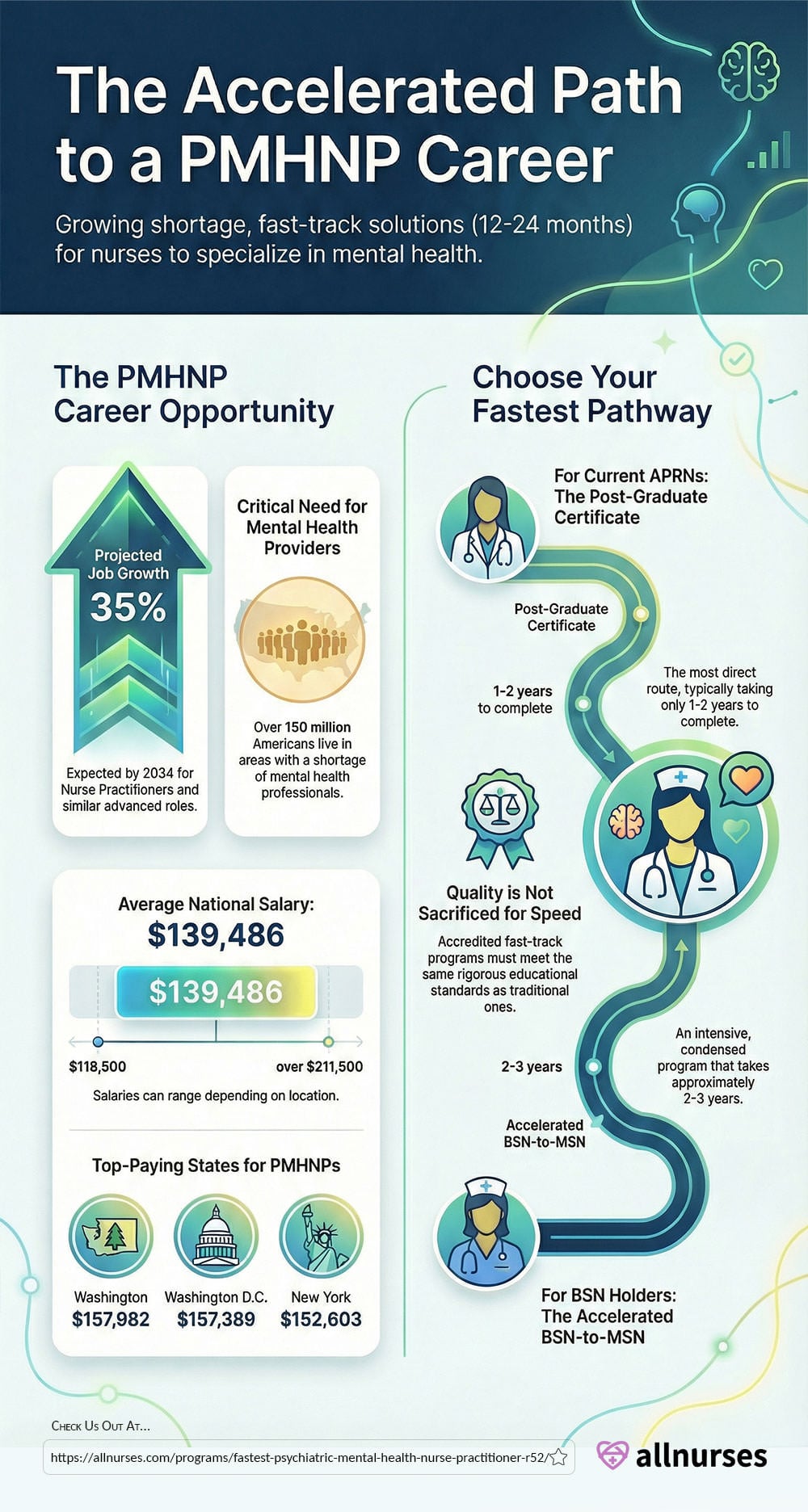

Use this graphic on your site:
Frequently Asked Questions
Can I work while enrolled in a fast PMHNP program?
Yes, many students in the fastest PMHNP programs are able to maintain employment during their studies. However, these accelerated programs are intensive, so it's important to assess whether you can balance work, coursework, and personal responsibilities. Some of the shortest PMHNP programs offer flexible online learning options to accommodate working nurses.
How long is a PMHNP program?
PMHNP programs usually range from 12 to 24 months, depending on the degree level and the school's format. Some post-master's certificate programs can be completed in as little as 1 year, while MSN-level programs may take up to 2 years. For example, Anderson University offers a 15-month certificate program, and Union University's MSN PMHNP program takes 16 months. These varied timelines give RNs the option to choose a pace that fits their goals and prior education.
What support services are available for students in accelerated online PMHNP programs?
Schools offering the fastest PMHNP programs often provide robust student support, such as academic advising, online tutoring, career services, and mental health resources. These services are especially beneficial for students enrolled in online programs, helping them stay on track and succeed in their accelerated studies.
Can I obtain my PMHNP online?
It is possible to pursue your PMHNP online through accredited programs. For the best options, consider the Best Online Psychiatric-Mental Health Nurse Practitioner (PMHNP) Programs in 2026.
Are Online PMHNP programs a good choice?
Online PMHNP programs are ideal for self-directed learners who value the convenience of studying remotely. They're particularly advantageous for those in rural or underserved areas, offering access to the shortest PMHNP programs without requiring frequent campus visits. Success depends on time management and comfort with virtual learning environments, making them a practical option for many nurses.
How hard is an accelerated PMHNP program?
Accelerated PMHNP programs can be challenging due to their fast pace and full workload. Students are expected to absorb complex psychiatric content quickly, complete clinical hours, and stay on top of frequent assignments with little downtime. It can feel overwhelming at times, especially for those also working or caring for others. For example, an RN in a 15-month program might need to cut back on work hours just to keep up with clinical shifts, coursework, and weekly deadlines. Staying organized and having support from an employer, family, or classmates can make a big difference in managing the demands of the program.
Are there any 1-year PMHNP programs available?
Yes, there are accelerated Post Master's PMHNP programs that can be completed in as little as one year. These programs are specifically designed for nurses who already hold an MSN or another advanced nursing degree, enabling them to specialize quickly in psychiatric-mental health.
Who is the ideal candidate for a 1-year PMHNP program?
The ideal candidate is an APRN—such as a Family Nurse Practitioner (FNP) or Adult-Gerontology Nurse Practitioner (AGNP)—who already holds an MSN and seeks to specialize in psychiatric-mental health. A 1-year PMHNP program is well-suited for experienced nurses who are prepared to handle a fast-paced curriculum and want to expand their scope of practice.
What factors should I consider before choosing a 1-year PMHNP program?
Before enrolling in a 1-year PMHNP program, you must hold a Master of Science in Nursing (MSN) degree, typically as an APRN or NP. Consider whether you can manage the program's rigorous, accelerated pace alongside your professional and personal commitments. Ensure the Post Master's PMHNP program is accredited, aligns with your career goals, meets your state's licensing requirements, and suits your preferred learning style, whether online or in person.
What is the difference between a PMHNP and a psychiatrist?
While both PMHNPs and psychiatrists are involved in diagnosing and treating mental health conditions, there are some differences in their training and approach to care. PMHNPs are APRNs with specialized training in psychiatric-mental health care. They follow a holistic approach to health care and often focus on combining therapy and medication management. Psychiatrists, on the other hand, are medical doctors who specialize in psychiatry. They primarily focus on medication management, although they may also provide therapy. Psychiatrists often work closely with PMHNPs and other mental health professionals to provide comprehensive patient care.
It's important to consult specific state regulations and practice guidelines to understand the full scope of practice for PMHNPs and their collaborative relationships with other healthcare providers in different jurisdictions.
Is the PMHNP field oversaturated?
While demand for Psychiatric-Mental Health Nurse Practitioners (PMHNPs) remains strong, some regions are experiencing increased competition due to growing interest in the specialty. Job saturation often depends on location, local mental health funding, and healthcare networks. Urban areas with many nurse practitioners may offer fewer openings compared to rural or underserved communities. For example, a PMHNP in a large city might struggle to find full-time roles, while one in a rural clinic could receive multiple offers due to provider shortages.