




ADN vs. ASN vs. AAS: Which Nursing Degree Is Right for You in 2026?


Deciding to become a registered nurse (RN) is a major life step. But before you can start caring for patients, you have to choose an educational path. For many, an associate's degree is the fastest and most affordable route to earning an RN license. According to the National Council of State Boards of Nursing (NCSBN), these programs are a vital pipeline for the healthcare workforce.
However, you'll quickly encounter a trio of acronyms: ADN, ASN, and AAS. While they all lead to the same goal, they are not identical. This guide will break down the differences between an Associate Degree in Nursing (ADN), an Associate of Science in Nursing (ASN), and an Associate of Applied Science in Nursing (AAS) to help you choose the best program for your career goals in 2026.
ADN vs. ASN vs. AAS: At a Glance
Best Overall for BSN Transfer: ADN (Associate Degree in Nursing). This is the most common and balanced associate's degree, providing a strong foundation in both theory and clinical practice that transfers easily to four-year universities.
Best for Science-Focused Learners: ASN (Associate of Science in Nursing). This degree is very similar to an ADN but may require more general education credits in science disciplines like chemistry and biology.
Best for Hands-On Learners: AAS (Associate of Applied Science in Nursing). This degree emphasizes practical, job-ready clinical skills over general education theory, designed to get you into the workforce quickly.
What Are Associate Degrees in Nursing?
An associate's degree in nursing is typically a two-year program that prepares you for entry-level nursing positions. These programs are offered at community colleges, technical schools, and some universities. They provide the foundational knowledge and hands-on clinical experience necessary to work as an RN.
Students in any of these three programs (ADN, ASN, or AAS) can use them as a starting point. Licensed practical nurses (LPNs) often use these tracks as bridge programs to become RNs. After graduation, you can also advance your education further by enrolling in RN to BSN bridge programs or even RN to MSN programs.
The Common Ground: NCLEX-RN Eligibility
The most important similarity among ADN, ASN, and AAS programs is that graduating from an accredited program makes you eligible to take the National Council Licensure Examination (NCLEX-RN). Passing this exam is the final step to earning your RN license and beginning your nursing career.
ADN vs. ASN vs. AAS: Key Differences Compared for 2026
While all three paths lead to the same license, their focus and structure differ. Understanding these differences is key to picking the program that aligns with your future goals.
| Feature | ADN | ASN | AAS |
|---|---|---|---|
| Primary Focus | Balanced mix of nursing theory, general education, and clinical practice. | Strong foundation in science and liberal arts alongside core nursing courses. | Heavy emphasis on technical, hands-on nursing skills and clinical application. |
| Clinical Emphasis | Comprehensive clinical rotations across various healthcare settings. | Substantial clinical hours, similar to an ADN. | The most intensive clinical and practicum requirements. |
| Common Institutions | Community colleges, some 4-year universities. | Community colleges and some 4-year colleges. | Technical colleges, vocational schools, hospital-based programs. |
| Best for BSN Transfer | Excellent. Credits are designed to transfer smoothly to BSN programs. | Very Good. General science credits are highly transferable. | Good, but may require extra general education courses to transfer. |
Deep Dive: What Is an ADN (Associate Degree in Nursing)?
The ADN is the most traditional and widely recognized two-year nursing degree. It offers a comprehensive curriculum designed to prepare students for the complexities of modern nursing while also laying the groundwork for future education.
ADN Curriculum and Focus
An ADN program provides a solid mix of general education courses, nursing-specific theory, and supervised clinical practice. You can expect courses covering essential topics from pediatrics and maternal health to psychiatric nursing and care management.
General Education: English, Anatomy & Physiology, Microbiology, Psychology, Statistics.
Nursing Courses: Nursing Concepts, Human Growth and Development, Pediatric Nursing, Maternal-Newborn Nursing, Psychiatric Nursing.
Common Institutions
ADN programs are most commonly found at community colleges and some four-year colleges. You can find excellent options in our guide to the Top 10 Fastest ADN Programs.
Who Is an ADN Best For?
An ADN is ideal for students who want a versatile degree that provides immediate career opportunities and a clear, straightforward path to a Bachelor of Science in Nursing (BSN) in the future.
Deep Dive: What Is an ASN (Associate of Science in Nursing)?
The ASN is functionally very similar to the ADN. The main distinction often lies in the general education requirements, with the ASN placing a slightly heavier emphasis on science and mathematics prerequisites.
ASN Curriculum and Focus
The core nursing coursework in an ASN program mirrors that of an ADN. The difference is that an ASN curriculum is built on a broader base of science-oriented general education, which can be beneficial for students who enjoy academic science and plan to pursue advanced practice degrees later.
General Education: College Composition, Anatomy & Physiology, Chemistry, Algebra, Microbiology.
Nursing Courses: Foundations of Nursing, Med-Surg Nursing, Community Nursing, Emergency Nursing.
Common Institutions
Like ADNs, ASN degrees are primarily offered at community colleges and technical schools. Fewer traditional universities offer the ASN designation compared to the ADN.
Who Is an ASN Best For?
The ASN is a great fit for students who excel in and enjoy science courses and want a degree that strongly signals a rigorous scientific foundation, which can be advantageous when applying to competitive BSN or MSN programs.
Deep Dive: What Is an AAS (Associate of Applied Science) in Nursing?
The AAS is the most career-focused of the three degrees. It is a technical degree designed to equip students with the practical, hands-on skills needed to excel in a clinical setting immediately after graduation.
AAS Curriculum and Focus
An AAS program minimizes general education requirements in favor of maximizing time spent in clinical rotations and skills labs. The curriculum is intensely focused on the direct application of nursing knowledge at the bedside.
General Education: Fewer liberal arts requirements. Typically includes English, Anatomy & Physiology, and Sociology/Psychology.
Nursing Courses: Introduction to Nursing, Nursing Throughout the Lifespan, Mental Health Nursing, Clinical Nursing Practicum.
Common Institutions
You will typically find AAS in nursing programs at vocational schools, technical colleges, and some training facilities affiliated with hospital systems.
Who Is an AAS Best For?
The AAS is perfect for students who want the fastest, most direct path to a hands-on nursing job and learn best by doing. It's also a great option for those who may be less certain about pursuing a BSN right away.
Career & Salary Outlook for Associate-Level RNs in 2026
Graduating with any of these associate's degrees opens the door to a rewarding and stable career. According to the Bureau of Labor Statistics (BLS), employment for registered nurses is projected to grow 6 percent from 2022 to 2032, faster than the average for all occupations.
Median Salary: The median annual wage for registered nurses was $86,070 in May 2023, with entry-level positions for associate-prepared nurses typically falling within this range.
Job Opportunities: RNs with associate's degrees are in demand in hospitals, long-term care facilities, clinics, and physician's offices.
It is important to note that many healthcare systems, particularly those seeking Magnet Recognition Program status, express a preference for hiring BSN-prepared nurses. However, the ongoing nursing shortage in 2026 ensures strong demand for qualified RNs at all education levels. Many employers even offer tuition assistance for ADN, ASN, or AAS graduates to complete their BSN.
How to Choose the Right Nursing Program for You
Deciding between an ADN, ASN, and AAS depends on your personal circumstances and professional ambitions. If you are still unsure, review our tips on How to Get Into Nursing School. Here are some key factors to consider:
Consider Your Long-Term Career Goals
Do you plan to eventually earn a BSN, MSN, or even a doctorate? If so, an ADN or ASN is often the more seamless path, as their general education credits are designed for easy transfer. If your primary goal is to become an RN and start working as quickly as possible, an AAS is an excellent choice.
Evaluate Your Learning Style
Do you thrive in a traditional academic setting with a balance of lecture and practice? An ADN or ASN might be a good fit. If you learn best by doing and want to spend most of your time in a clinical environment, the AAS path will likely be more rewarding.
The Non-Negotiable: Program Accreditation
Regardless of which degree you choose, you must ensure the program is accredited by either the Accreditation Commission for Education in Nursing (ACEN) or the Commission on Collegiate Nursing Education (CCNE). Graduating from an accredited program is required to sit for the NCLEX-RN and is necessary for transferring credits to a BSN program later.
Infographic: ADN, ASN, or AAS? Choosing Your Nursing Path
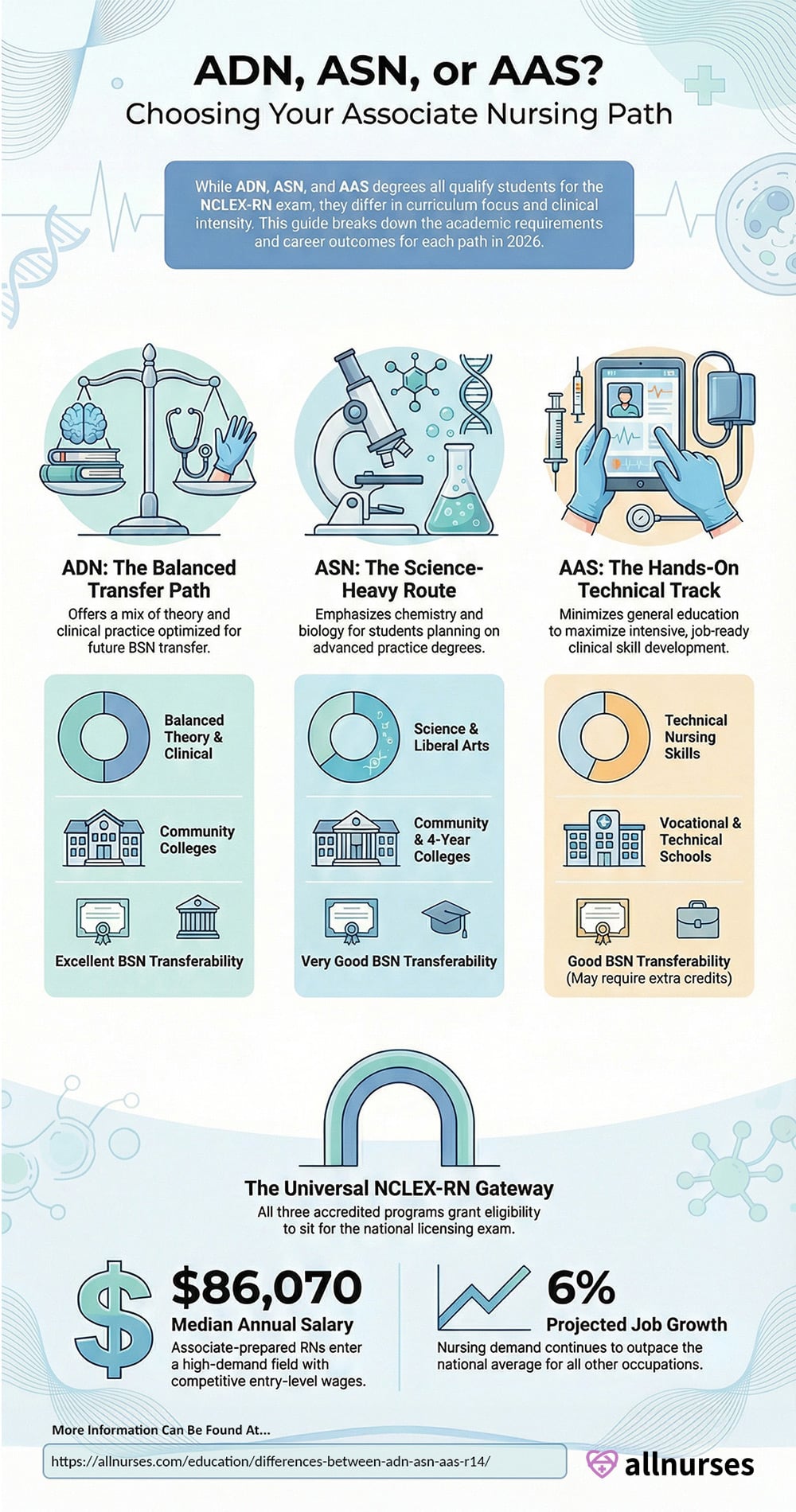
Embed Code:
Frequently Asked Questions
Is an ADN, ASN, or AAS graduate considered a "real" nurse?
Yes. Upon passing the NCLEX-RN exam, graduates of all three accredited programs are licensed as Registered Nurses (RNs) with the same legal scope of practice.
Do credits from an AAS degree transfer to a BSN program?
Many credits will, especially the core nursing courses. However, because AAS programs have fewer general education requirements, you may need to take additional courses like history, advanced math, or literature before being fully accepted into a BSN program. Always check with the BSN program you plan to attend.
Which degree is the fastest: ADN, ASN, or AAS?
All three programs generally take about two years of full-time study to complete. There is no significant difference in the time commitment.
Can I get a good job with an associate's degree in nursing in 2026?
Absolutely. The demand for RNs remains high across the country. While some hospitals in major urban areas may prefer BSN-prepared nurses, there are abundant opportunities for associate-level RNs in a wide variety of healthcare settings.
ADN vs. ASN vs. AAS: Which is best for you?
The "best" degree is the one that aligns with your life. Factors like program cost and local availability are key, but you should also consider your future. If you see a Master's degree in your future, the ADN is generally the most "transfer-friendly" option. That said, all three degrees lead to the same result: eligibility for the NCLEX-RN and a license to practice.
How many years will I be in school?
Typically, you can expect to graduate in about two years. Choosing an associate track over a four-year BSN means you can start working at the bedside and gaining real-world experience much sooner. Many schools offer flexible schedules for working students, and accelerated ADN programs can help you jumpstart your career in record time.
What is the ROI on an associate degree in nursing?
The return on investment is high. These programs offer the fastest path to a stable, well-paying career in patient care. According to BLS data, the median pay for registered nurses is $77,600. While pay scales vary based on where you live and your clinical specialty, an associate degree is a proven gateway to financial stability and professional growth.
NOTICE AN ERROR? We strive for absolute accuracy. If you spot an outdated guideline, a calculation discrepancy, or a factual error, Contact Us.